What A Real Content Workflow Looks Like From Brief To Publish

A real content workflow takes a brief through research, outlining, drafting, review, updating, approval, publishing, and promotion—an eight-stage example supported by Slickplan. [1] [1] The wider process also covers strategy, SEO, roles, tools, quality gates, and performance tracking. Your brief should address nine essential components, although the ledger doesn’t list all nine. [2]

  • An example content workflow contains eight stages, from research through promotion. [1] [1]
  • An effective content brief is described as containing nine essential components. [2]
  • A standard blog-post brief should typically be one to three pages. [2]
  • Lark’s Basic plan is reported at $6 per user per month when billed annually.
  • The ledger does not establish universal workflow timings, approval gates, revision rounds, or KPI thresholds.

What are the essential stages in a content workflow from brief to publish and how many steps does a typical process include?

A content workflow is a structured process that moves content from an initial concept to final publication. The clearest worked example contains eight stages: research, outline, draft, review copy, update copy, approve, publish, and promote. [1] [1] [1] [1] [1] [1] [1] [1]

A broader content creation process groups the work into strategy and planning, ideation and topic selection, briefing and pre-production, creation and production, editing and quality review, approvals and compliance, publishing and distribution, and performance tracking and optimization. These are two views of the same content management problem: one names concrete tasks, while the other describes phases.

You can manage the process as a task-based workflow, where each step has an owner and due date, or as a status-based workflow, where progress is represented by states such as “In Review” and “Published.” [3] [3] Sequential workflows require each task to finish before the next begins; parallel workflows run independent activities simultaneously; state-machine workflows move work through approvals, revisions, and feedback loops. [4] [4] [4] The ledger doesn’t establish one universal step count, so eight steps are a practical example, not a mandatory standard.


What a Real Content Workflow Looks Like from Brief to Publish - A clean editorial kanban board as the sole subject, shown in a modern studio setting, with blank color-coded cards progressing through columns from br...
A clean editorial kanban board as the sole subject, shown in a modern studio setting, with blank color-coded cards progressing through colum…
A polished editorial workflow icon: a single seamless conveyor belt carrying a manuscript through eight distinct stages, symbolized by research notes,...
A polished editorial workflow icon: a single seamless conveyor belt carrying a manuscript through eight distinct stages, symbolized by resea…

Find your new What A Real Content Workflow Looks Like From Brief To Publish on this page.

What specific elements should a content brief contain and how many components are recommended for an effective brief?

A content brief explains what you need, why you need it, and how the finished work should look before writing begins. [2] The recommended effective brief contains nine essential components. [2] The ledger doesn’t provide a complete list of all nine, so you shouldn’t treat the available examples as exhaustive.

Supported components include strategic objectives and success metrics, which define the business purpose; target audience and journey stage, including mindset, pain points, and awareness rather than demographics alone; and content format and structure, including specifications such as word count, video length, or slide count. [2] [2] [2] SEO and keyword planning is also a required phase in a content publishing workflow. [3]

The brief-creation process is described as five steps. [2] The first is defining strategic goals and KPIs, while another documents execution guidelines by centralizing research, templates, and brand guidelines. [2] [2] For a standard blog post, expect the brief to be one to three pages. [2] That length gives a writer direction without turning the brief into the article itself.

A polished content brief document resting on a clean desk beside a laptop, with nine neatly arranged visual sections represented by subtle colored blo...
A polished content brief document resting on a clean desk beside a laptop, with nine neatly arranged visual sections represented by subtle c…

Who should be involved at each stage of the workflow and what are the handoff points?

A project manager or content manager is usually the point person who develops and executes the publishing plan. [1] Before production begins, planning and resourcing align scope, timing, and capacity, while budget considerations include writers, editors, and design. [5] [6] A practical ownership map assigns the writer to drafting, the editor to review and updating, the designer to visual work, the producer to coordination and production, the approver to the final decision, and the publisher to the CMS handoff where the workflow supports those roles. [6] [5]

Use a RACI model to distinguish who is responsible, accountable, consulted, and informed. [5] Every meaningful stage, decision, and handoff should have one accountable owner, even when several people contribute. [7] Align stakeholders during planning and outlining so they can shape the scope before writing starts. [8] [8]

For cross-functional or remote teams, centralized tools can consolidate tasks, communication, progress, and visibility. [4] [9] Clear ownership matters: unclear roles can cause work to be duplicated or neglected, while poor information transfer can degrade the work as it crosses handoffs. [4] [9]

Create a clean editorial-style image of a project workflow baton being passed between diverse hands, symbolizing roles, responsibilities, collaboratio...
Create a clean editorial-style image of a project workflow baton being passed between diverse hands, symbolizing roles, responsibilities, co…

What tools or software categories are used for drafting, editing, review, approval, and publishing?

Content teams typically combine drafting, editing, SEO, workflow management, approval automation, and CMS publishing rather than relying on one tool. AI drafting tools such as Jasper, Copy.ai, and Rytr can generate multiple versions, while Grammarly and QuillBot automate grammar and style checks. [6] [6] SurferSEO and Clearscope address keyword research and content optimization, making SEO a separate part of the content creation process. [6] [3]

Category Primary use Ledger-supported examples or capability
Drafting Generate initial versions Jasper, Copy.ai, and Rytr generate multiple versions. [6]
Editing Check grammar and style Grammarly and QuillBot automate checks. [6]
SEO Plan keywords and optimize content SurferSEO and Clearscope support keyword research and optimization. [6]
Workflow management Centralize tasks, progress, and communication Centralized workflow tools consolidate these elements. [4]
Automation Reduce repetitive coordination Request forms, assignments, reminders, and status-triggered notifications can be automated. [5] [2]
Asset handling Store content files Lark supports.docx,.xlsx,.pptx,.txt, and.png.

Lark’s reported example includes a free Starter plan for up to users and a Basic plan priced at $6 per user per month when billed annually for up to users. The ledger contains no supported feature or pricing evidence for Trello, Asana, WordPress, or Webflow, and no direct comparison with monday.com or Slickplan. Those comparisons remain unknown.

A polished editorial workflow control panel as the single subject, surrounded by subtle visual cues for drafting, editing, SEO analysis, approvals, an...
A polished editorial workflow control panel as the single subject, surrounded by subtle visual cues for drafting, editing, SEO analysis, app…

What is a typical timeline with time allocations for each workflow stage?

A reliable stage-by-stage timeline in hours or days for a standard blog post isn’t provided by the ledger. The available figures should therefore be treated as workload context, not as a schedule for briefing, research, drafting, editing, approval, or publishing.

One report says teams spend more than four hours crafting long-form content. [8] Another recommends a conversion-focused article of no more than words and suggests that the article could take about minutes to write. [8] [8] Those figures describe different approaches and don’t establish a universal production time. Broader creator data reports weekly time ranges, including one to five hours for 36% of creators, to hours for 9%, and more than hours for 5%. [6]

You can reduce waiting when independent creative activities run in parallel rather than strictly in sequence. [9] Parallel workflows allow simultaneous work when activities don’t depend on one another. [4] The exact allocation for each stage remains unknown, so a responsible plan should measure your own workflow rather than borrow unsupported time estimates.

Discover more about the What A Real Content Workflow Looks Like From Brief To Publish.

What quality checks, approval gates, and revision rounds are commonly required before publishing?

A pre-publication quality check should cover grammar, flow, and factual details. [3] Images should also have clear alt text and accurate filenames describing what they show. [3] These checks belong before the distinct approval gate, where an editor or content manager gives final approval after review and updating. [1]

Revision expectations vary by source. One account expects one to two editing rounds, while another reports that most content receives at least two rounds of revisions. [8] [5] The evidence supports planning for review and feedback, not promising one fixed number for every assignment.

Consistent communication and feedback loops are intended to catch issues early and reduce revisions and backtracking. [1] Digital approval is another workflow-automation example: Kellogg’s cut half of its legal review meetings after moving to a digital approval workflow. [5] That result is specific to Kellogg’s and shouldn’t be generalized to every team. The ledger doesn’t establish a universal number of approval gates or revision rounds.

What measurable KPIs should you track after publishing, and what actions should follow?

Performance tracking and optimization should measure results against the objectives and success metrics defined in the brief. [2] Engagement rate is one post-publish metric; the available report describes a 2% engagement rate for the long-form content it discusses. [8] For video, views, watch time, and audience retention are identified as crucial metrics. [6]

Your measurement plan can also include conversion rate, engagement time, lead quality, audience segmentation, traffic, and content updates when those measures match the content strategy. The ledger provides no common thresholds or evidence-backed follow-up rules for those categories, so the trigger for revising, repurposing, or updating content remains unknown.

Review the workflow monthly to improve productivity and quality. [5] For Content Systems Desk readers, that review can examine how AI-assisted drafts move through professional editing, fact-checking, and human expertise. The ledger supports combining those activities as a workflow perspective, but it doesn’t provide evidence that the combination improves a particular KPI.

See the What A Real Content Workflow Looks Like From Brief To Publish in detail.

Content specification guidance (format, length, images, file types) (compiled from sources)
Source Content format & structure specs Article/introduction/body/brief length guidance Image alt text / filename guidance Supported file formats
monday.com Content format and structure should specify content type and specs such as word [2] A content brief should typically be one to three pages for standard blog posts. [2]
linkedin.com The author recommends a words maximum article length as a conversion-focused [8] [8] [8]
activepieces.com Every image should have clear alt text and accurate filenames that describe what [3]
larksuite.com Lark supports uploading common file formats such as.docx,.xlsx,.pptx,.txt, a
Workflow, automation, and revision expectations (compiled from sources)
Source Assignment / automation on status change Editing / revision rounds expected Workflow tooling / automation recommendations Accountability model
monday.com When brief status changes to "Approved," the platform automatically assigns writ [2]
linkedin.com The author states that one to two rounds of editing is expected to get content t [8]
screendragon.com Most content goes through at least two rounds of revisions. [5]
mitti.com Use centralized workflow tools to adopt software that consolidates tasks, progre [4] [4]
blog.workhint.com Every meaningful stage, decision, and handoff in a workflow should have one acco [7]
whispertranscribe.com Jasper, Copy.ai, and Rytr can automate the drafting process and generate multipl [6] [6] [6]
Category Primary feature Supported example or capability Claim key
Drafting Generate initial content versions Jasper, Copy.ai, and Rytr c_0066
Editing Automate grammar and style checks Grammarly and QuillBot c_0067
SEO and keyword planning Research keywords and optimize content SurferSEO and Clearscope c_0068
Centralized workflow management Consolidate tasks, progress, and communication Centralized workflow tools c_0097
Workflow automation Handle requests, assignments, reminders, and notifications Automated forms, assignments, reminders, and status changes c_0106; c_0010
File and asset handling Upload common content files Lark supports.docx,.xlsx,.pptx,.txt, and.png c_0045

Key Takeaways

  • Use eight stages as a clear working model, not a universal rule. [1]
  • Keep the brief focused on objectives, audience, format, SEO planning, and execution guidance. [2] [2] [2] [2]
  • Assign one accountable owner to every meaningful stage, decision, and handoff. [7]
  • Treat available time figures as context rather than fixed stage allocations. [8] [8]
  • Choose post-publish KPIs from the brief’s objectives, then review the workflow monthly. [2] [5]

Frequently Asked Questions

What is a good workflow for content creators?

A good workflow moves content from a brief through research, outlining, drafting, review, updating, approval, publishing, and promotion. A project or content manager coordinates the plan, while writers, editors, designers, producers, approvers, and publishers contribute at defined handoffs. [1] [1] [1]

Is content creation still worth it in 2026?

The ledger doesn’t establish whether content creation is still worth doing in 2026. It does support treating content as a managed process with defined objectives, success metrics, performance tracking, and optimization. [2]

What are the steps of content creation?

One eight-stage content creation sequence is research, outline, draft, review copy, update copy, approve, publish, and promote. The ledger doesn’t establish a universal seven-step model. [1] [1] [1]

What are the steps of workflow?

The ledger does not define one universal five-step workflow. A brief-creation process is described as five steps, including defining strategic goals and KPIs and centralizing research, templates, and brand guidelines. [2] [2] [2]

Sources

  1. Breaking Down the Step Process
  2. Templates, Examples, and Key Steps (2026-02-26)
  3. How to Build a Content Publishing Workflow (2025-10-10)
  4. Workflow Management: The Ultimate Guide (2025-12-15)
  5. How to Build a Content Creation Workflow that Works (2026-04-23)
  6. Content Creation Workflow: Master Your Creative Process (2025-04-24)
  7. How To Define Roles And Responsibilities In A Workflow (2026-07-01)
  8. Streamline Content Creation with a Well-Designed Workflow | Wrike posted on the topic (2026-01-30)
  9. Organizational Workflow and Its Impact on Work Quality – Patient Safety and Quality

What A Ghostwriter Actually Does Versus An AI Writing Tool

Choose a professional ghostwriter when you need human-crafted voice, 10–30 hours of interviews and 2–4 hours per chapter of review, and legal clarity; choose an AI writing tool when you prioritise speed and cost — AI can cut drafting time by 60–80% and some AI book products cost $0–$19.99/month for 40k–60k words [1] [1] [2].

  • A ghostwriter “makes your personality shine” in writing [3].
  • AI can cut drafting time by 60–80% and significantly reduce cost [1].
  • Professional nonfiction ghostwriters cost $5,000–$50,000 for a 40,000–60,000 word book, with elite rates at $75,000–$250,000+ [2].
  • An AI book writer option can cost $0–$19.99 per month and some products include cover design and EPUB export in that price [2].
  • U.S. law and recent court decisions require human authorship for copyright protection and have found autonomously generated AI work not copyrightable [4] [4].

What specific services and deliverables does a professional ghostwriter provide that an AI writing tool does not?

Professional ghostwriters provide human-centred services — they make your personality shine and tailor wording to your voice [3].

A ghostwriter builds from your thoughts, not just prompts, and acts as a human collaborator you can bounce ideas off in real time [3].

A ghostwriter will tell you what they think and can represent you in person at events or meetings, offering judgment and presence an AI cannot provide [3] [3].

Typical traditional workflows start with a discovery call and recorded interviews, and you should expect to hours of interviews plus to hours per chapter for review and comments with a human ghostwriter [1] [1].

Many human ghostwriter quotes exclude separate editorial fees for developmental edits, copyedits, and proofreading, so budget those as listed extras [2].

By contrast, AI-powered tools improve efficiency for brainstorming, research, grammar checks and citation organization and can cut drafting time by 60–80%, but they primarily generate first drafts and revisions rather than the full partnership a human provides [5] [1] [1].

Guidance explicitly permits generating initial drafts that will be revised later while warning against leaving generated text unrevised for legal reasons [5].

What A Ghostwriter Actually Does Versus An AI Writing Tool
Photo via Unsplash
Single vintage fountain pen resting on an open leather notebook beside a small voice recorder and a coffee cup, warm natural window light, shallow dep...
Single vintage fountain pen resting on an open leather notebook beside a small voice recorder and a coffee cup, warm natural window light, s…

Check out the What A Ghostwriter Actually Does Versus An AI Writing Tool here.

What objective criteria should determine choosing a human ghostwriter versus an AI writing tool?

The G.A.P.E. Framework helps you choose between approaches by evaluating Goals, Assets, Personality, and Economics for your project [1].

If your priority is consistent literary voice, confidentiality, and a human partnership for complex projects, traditional ghostwriting is commonly recommended and often costs more: professional nonfiction ghostwriters run roughly $5,000–$50,000 for a 40,000–60,000 word book, with elite practitioners charging $75,000–$250,000+ [2].

If your main constraints are time and budget, AI book writers cost far less — $0–$19.99 per month for comparable word counts on some products — and can produce drafts much faster [2].

Consider the cost gap as part of the decision: in the price difference between traditional ghostwriters and an AI book writer ranged roughly 250x to 12,500x, which materially affects who should handle strategy, voice, and sensitive material [2].

Also factor timeline: serious ghostwritten nonfiction typically takes months while AI routes can produce drafts in weeks, so choose by complexity and schedule as well as money [2] [2].

What A Ghostwriter Actually Does Versus An AI Writing Tool
Photo via Unsplash

What are the typical price ranges and turnaround times for hiring a ghostwriter compared with subscription or pay-per-use AI writing tools?

Ghostwriter pricing and turnarounds vary widely by experience and scope: a professional nonfiction ghostwriter costs $5,000–$50,000 for a 40,000–60,000 word book, with elite rates reaching $75,000–$250,000+ [2].

Pricing tiers for that same word count show beginner ghostwriters at $5,000–$15,000, mid-tier professionals at $20,000–$50,000, and elite ghostwriters at $75,000–$250,000+ [2].

Editorial rates can also be charged per word, with a guide listing $0.50–$1.25 per word and experienced members at $1.25–$3.00 per word, which affects total production costs [2].

By contrast, an AI book writer option can cost $0–$19.99 per month and some products include cover design and EPUB export in that price, with one product charging $19.99 total to ship a 60,000-word nonfiction book in a month [2] [2] [2].

The practical cost gap in was roughly 250x to 12,500x between ghostwriters and AI book writers [2].

Turnaround time differs: serious ghostwritten nonfiction typically takes to months, while AI book writer routes can produce comparable drafts in to weeks and AI-assisted drafting surveys report 4–8 weeks for first drafts plus additional editing time [2] [2] [1].

Hybrid and AI-centric workflows can span a broad range: a professionally edited AI draft might cost $2,500–$5,800, while AI-first tool subscriptions often cost $20–$200/month and combined editor/strategist packages can run $5,000–$20,000 [2] [1] [1].

What A Ghostwriter Actually Does Versus An AI Writing Tool
Photo via Unsplash

How do copyright, attribution, and legal risks differ when publishing work produced by a human ghostwriter versus content generated by an AI?

The legal landscape for AI and copyright has been under active review since the U.S. Copyright Office launched an AI initiative on March 16, [6] [6] [6].

The Office received over 10,000 public comments by December and has published multi-part reports: Part on digital replicas (July 31, 2024) and Part on copyrightability of AI outputs (Jan 29, 2025), with a pre-publication Part released May 9, and a final version expected later [6] [6] [6] [6] [6].

U.S. copyright law requires human authorship for protection, and courts have found autonomously generated AI work not copyrightable in some decisions, creating a key legal distinction between human ghostwriting and fully AI-generated text [4] [4].

Guidance explicitly notes that wholly AI-generated text has copyright limitations and that the Copyright Office has ruled such material is not protected by copyright in some rulings [5].

Ghostwriters are described as helping ensure you own your ideas, which addresses traditional authorship and attribution in ways AI outputs currently do not [3].

At the same time, commentators raise ethical concerns about AI training and outputs taking from others, and litigation has produced mixed rulings on training data, fair use, and prohibited uses of pirated content [3] [4] [4].

Practical steps recommended include preventing uploaded materials from being used for model training, using tool checkboxes or professional/team versions that do not train public models, and reviewing commercial-rights terms such as those that grant 100% commercial rights on certain AI plans [5] [5] [5] [2].

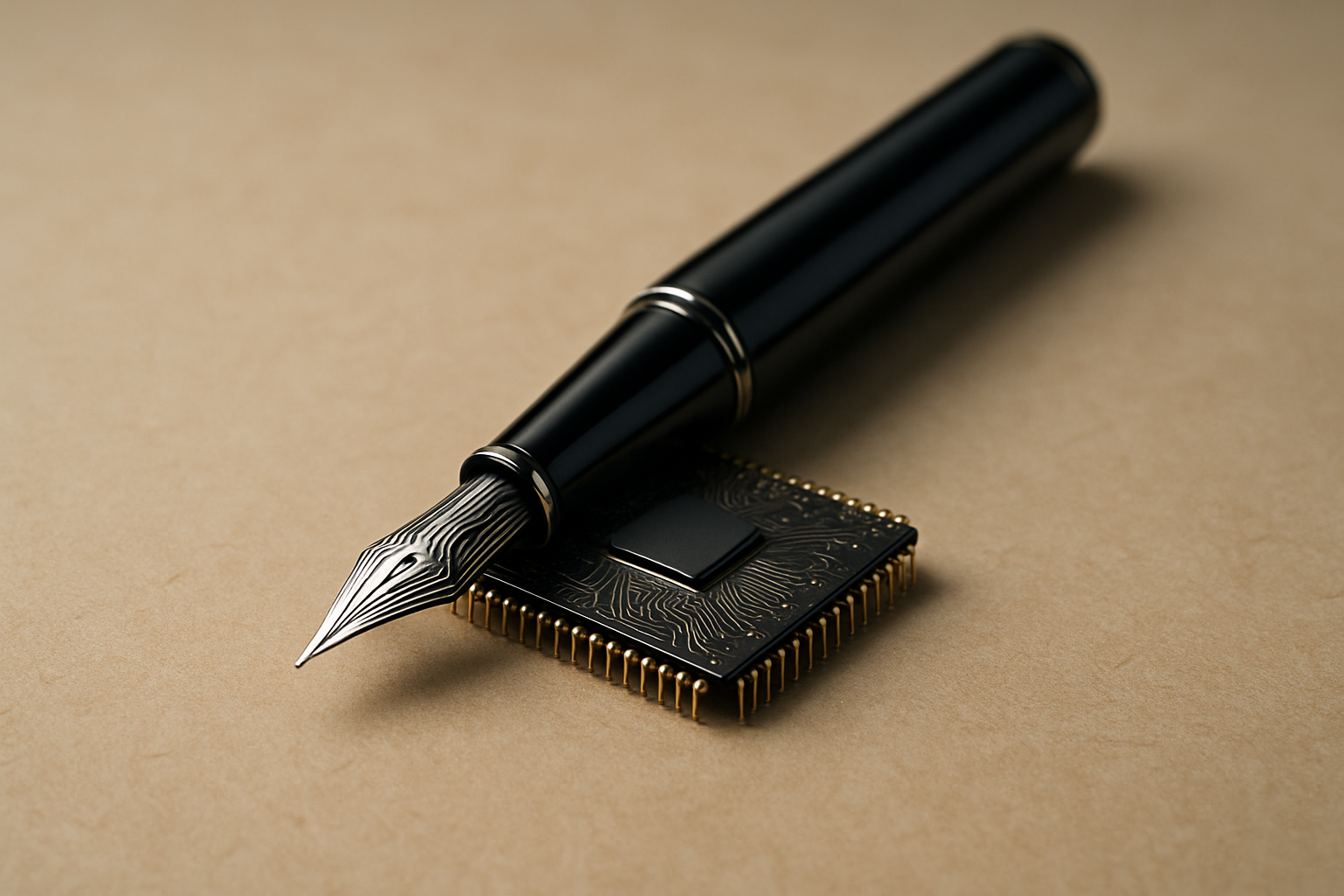
A single hybrid object: an elegant fountain pen fused with a sleek microchip body, nib subtly made of circuitry, warm textured paper beneath, soft dir...
A single hybrid object: an elegant fountain pen fused with a sleek microchip body, nib subtly made of circuitry, warm textured paper beneath…

What step-by-step process should a client follow to manage drafts, revisions, interviews, and approvals with a ghostwriter versus with an AI tool?

Managing a human ghostwriter starts as a partnership: ghostwriting is described as a partnership and clients should be transparent about AI use when applicable [5] [5].

Begin with a discovery call, then schedule recorded interviews — typical traditional processes cite to hours of recorded interviews over Zoom as a starting structure [1].

Plan for deep interviewing: expect to hours of interviews plus to hours per chapter for your review and comments when you hire a human ghostwriter [1].

For AI-first workflows, work in shorter, more frequent review cycles: many users review AI output in to minutes per section and iterate rapidly [1].

Use AI to generate first drafts and guided revisions, since AI ghostwriting is defined as using large language models to create initial drafts and edits from your inputs, but follow guidance that generating drafts intended for later revision is the recommended use and leaving generated text unrevised is discouraged for copyright reasons [1] [5].

Check out the What A Ghostwriter Actually Does Versus An AI Writing Tool here.

What common quality, factual, and ethical risks are more likely with AI-generated content compared to human-written ghostwritten content?

AI-generated content often lacks a genuine human element and can feel cold, uncaring, or lazy to readers, which affects reader engagement and perceived craft.

Research and commentary indicate psychological and cognitive risks: using ChatGPT to write essays has been linked to ‘cognitive debt' and lower learning outcomes, and ChatGPT users showed lower brain engagement and underperformed versus other methods in some measurements.

Relying on AI for all writing risks stunting your development as a writer and makes it harder to discover and develop your literary voice.

Practically, ChatGPT outputs often need edits because they can be clunky, repetitive, and not reflective of the author's original ideas, and commentators warn that AI can lie or “gaslight” users about facts and authorship [7] [3] [3].

Publishers and practitioners note that AI is transforming publishing but brings trade-offs: human-created writing preserves originality, taste, and wit that some say AI lacks, and guidelines caution that AI tools are not dependable for identifying or checking facts [5] [5] [5].

What verification steps should you perform before publishing whether you used a ghostwriter or an AI tool?

All writers for hire, including ghostwriters, should disclose any AI use to clients and publishers, so require written disclosure up front [5].

If you or your writer uploads proprietary material to generative tools, take steps to prevent those materials from being used for training by using available checkboxes or choosing professional/team versions that do not train public models [5] [5] [5].

Do not leave generated text unrevised if you expect copyright protection: guidance explicitly recommends generating initial drafts that will be revised later and warns against publishing unrevised AI-only text due to copyright risk [5].

Budget separately for developmental editing, copyediting, and proofreading when hiring humans, since many ghostwriter quotes list these as separate costs [2].

Finally, consult a lawyer to embed verification and ownership principles into your contracts because published guidelines are not a substitute for legal advice [5].

If you use Content Systems Desk resources, apply those processes to combine AI with professional editing and human expertise when you prepare to publish.

Click to view the What A Ghostwriter Actually Does Versus An AI Writing Tool.

Cost comparison of ghostwriters and AI book writers in (USD) (compiled from sources)
Type Price Range for 40,000-60,000 word book Monthly Cost Additional Notes
Beginner ghostwriters [2] $5,000-$15,000 [2]
Mid-tier professional ghostwriters [2] $20,000-$50,000 [2]
Elite ghostwriters [2] [2] $75,000-$250,000+ [2] [2]
AI book writer (Inkfluence AI Premium) [2] [2] [2] Included in monthly cost [2] $0-$19.99 per month flat [2] [2] Includes cover design and EPUB export; $19.99 total for a 60,000-word nonfiction [2] [2] [2]
Hybrid workflow (AI draft plus human editor) [2] $2,500-$5,800 [2] Produces a professionally edited 60,000-word book [2]
Experienced business-book ghostwriters [1] $30,000-$75,000 (top-tier >$100,000) [1]
AI-centric workflows with editor and strategist [1] $5,000-$20,000 (few hundred $ tools + time to $20k) [1] $20–$200 per month for AI-first tools [1] Includes professional editor and strategist option [1]
Time comparison for producing nonfiction books by ghostwriters versus AI workflows in 2026-2027 (compiled from sources)
Method Typical Time to Produce Draft Additional Time for Editing/Review Total Typical Time
Professional ghostwriter [2] [1] 6 to months [2] 6 to months (Reedsy survey 2023) [1]
AI book writer draft alone [2] [1] 2 to weeks (Inkfluence AI 2026) [2] 4 to weeks (AI-assisted drafting survey) [1]
AI-assisted drafting plus editing [1] 4 to weeks for drafting [1] 6 to weeks for editing [1] Total to weeks [1]
Type Price for 40k-60k words Typical time to produce draft
Beginner ghostwriter $5,000-$15,000 6-18 months (typical human timeline)
Mid-tier ghostwriter $20,000-$50,000 6-18 months (typical human timeline)
Elite ghostwriter $75,000-$250,000+ 6-18 months (typical human timeline)
AI book writer (Inkfluence AI Premium) $0-$19.99 per month (includes cover and EPUB export) 2-4 weeks for a comparable draft
Hybrid (AI draft + human editor) $2,500-$5,800 (professionally edited 60k-word book) 4-8 weeks drafting + editing time

Key Takeaways

  • If voice, representation, and in-person presence matter, hire a ghostwriter who builds from your thoughts and acts as a human collaborator [3].
  • If speed and budget are primary, use an AI book writer but plan for editing and legal review because AI drafts should be revised before publishing [2] [5].
  • Budget separately for developmental, copy, and proofreading edits when using humans since those are often listed as extra costs [2].
  • Protect proprietary uploads and limit model training by using tool checkboxes or professional/team versions that do not train public models [5] [5].
  • Require disclosure of AI use from any writer-for-hire and consult a lawyer to embed verification and ownership terms into contracts [5] [5].

Frequently Asked Questions

Can AI be used as a ghostwriter?

Yes — AI can be used to produce first drafts and revisions as part of ghostwriting workflows, because AI ghostwriting is defined as using large language models to generate first drafts and revisions based on your inputs and guidance [1].

Is it illegal to publish a book written by AI?

Publishing AI-generated text can create copyright uncertainty because U.S. law requires human authorship for copyright protection and courts have found autonomously generated AI work not copyrightable [4].

How to tell if a writer uses AI?

You should ask the writer directly and require disclosure: guidelines say all writers for hire, including ghostwriters, should disclose the nature of their AI use to clients and publishers [5].

What does a ghost writer actually do?

A professional ghostwriter shapes your voice, builds from your thoughts, and serves as a human partner for interviews and feedback, including recorded interviews and discovery calls [3] [3] [1].

Sources

  1. AI Ghostwriting: How It Compares to a Human Ghostwriter (2026-07-04)
  2. What a Nonfiction Book Really Costs (2026-04-27)
  3. Ghostwriting vs AI: Key Differences | Stuart Groves posted on the topic (2026-08-27)
  4. AI and Authors' Rights – Copyright
  5. AI Guidelines | Gotham Ghostwriters (2026-04-06)
  6. Copyright and Artificial Intelligence | U.S. Copyright Office
  7. Comparing AI and ghostwriting (2023-05-15)