
How To Build A Content Workflow That Scales Past One Writer

A scalable content workflow connects writers, editors, project managers, designers, reviewers, and publishers through documented stages, clear owners, deadlines, QA, and approval. Start by testing the workflow against five existing pages, then measure throughput, revision rate, citations, engagement, and quality before expanding it across your calendar [1] [2].

  • A content workflow is a pre-established set of steps for creating, reviewing, and delivering content [1].
  • Each task-based workflow step specifies the work, responsible person, and due date [1].
  • A short blog post may need one or two revision rounds, while a comprehensive white paper may need several stakeholder reviews [1].
  • Time to publish is the average time from a raw idea to a live piece of content [3].
  • AI-generated output should receive human review before publication and should not be published as-is [4].

What stages and handoffs should a multi-writer content workflow include, from brief through publication?

A documented content workflow is a pre-established set of steps for creating, reviewing, and delivering content [1]. For a multi-writer team, begin with ideation, audience research, content planning, and a structured content brief; continue through drafting, editing, QA, approval, publishing, and content distribution. The exact sequence should be written down rather than left to memory.

Each workflow stage should name its work, responsible person, and due date [1]. A scalable content production system also needs structured inputs, defined roles, QA and validation, and measurement feedback loops [5].

Use a Kanban board whose columns represent workflow stages and show where each project stands [3]. Make handoffs among writing, design, and review visible so a project doesn't quietly wait between owners [3]. For AI-assisted work, schedule human review after ideation, after drafting, and before publication [2]. Reviewed drafts can move into the CMS as unpublished drafts for editor approval [2].


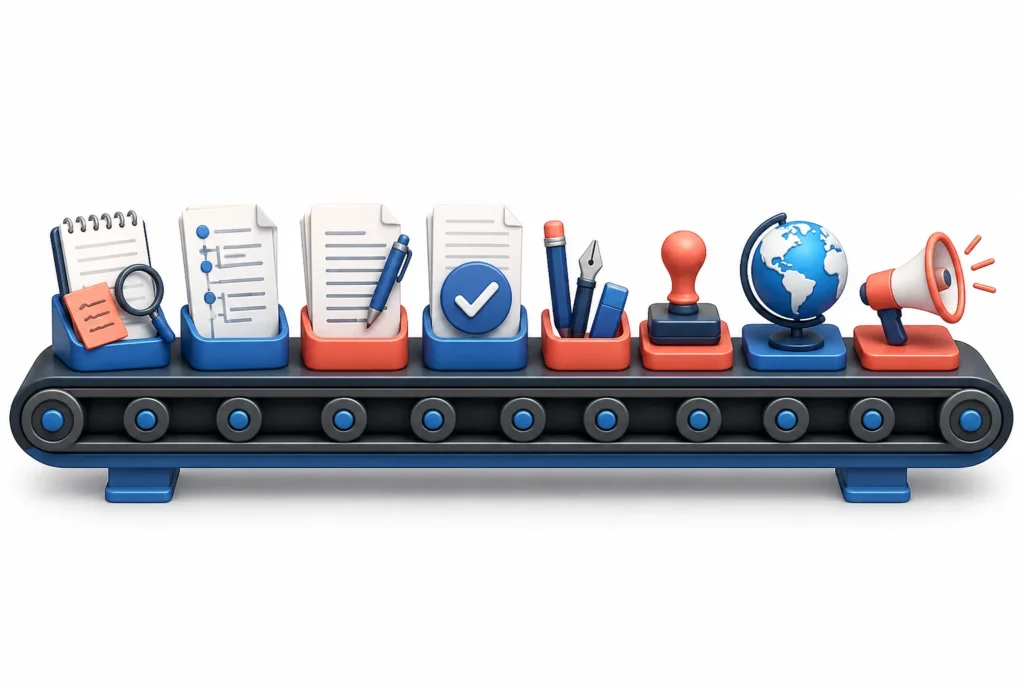
A polished editorial illustration of a scalable content workflow: a modular conveyor system carrying blank paper sheets through organized stages, with...
A polished editorial illustration of a scalable content workflow: a modular conveyor system carrying blank paper sheets through organized st…
A polished editorial illustration of a miniature content workflow represented by a connected series of blank cards moving across a clean Kanban board,...
A polished editorial illustration of a miniature content workflow represented by a connected series of blank cards moving across a clean Kan…

Which roles and responsibilities are needed when content production expands beyond one writer?

A multi-writer content team may involve writers, editors, project managers, designers, legal reviewers, and developers [1]. You don't need every role on every assignment, but every workflow stage needs an owner, including final review approval, with clear responsibilities and deadlines [1].

Separate editing from QA: editing improves the piece, while QA enforces standards [5]. A strategist sets topics and aligns them with business goals; a content manager organizes the editorial calendar and keeps deadlines visible; an SEO specialist researches keywords and optimizes for search; and an editor checks grammar, style, and brand voice [6]. Distribution roles cover social media, email, and paid media, while a content analyst can gather analytics and report effectiveness without being a full-time team member [6] [7].

AI systems also require separate editorial judgment and engineering or workflow-building skills, which rarely belong to one person [8].

Create a clean editorial-style illustration of a content production workflow represented by a single organized desk with a laptop, manuscript pages, e...
Create a clean editorial-style illustration of a content production workflow represented by a single organized desk with a laptop, manuscrip…

How should a team decide how many writers, editors, and reviewers to assign based on its publishing volume?

Staffing should start with publishing frequency, team bandwidth, and business goals, connected through an editorial calendar [1]. Count the work in your documented stages: briefs, drafts, editing, fact-checking, SEO review, design, approval, publishing, and distribution. Then look for the stage where projects wait or repeatedly return.

A workflow can scale to larger content volumes while maintaining consistency, but scale depends on defined roles, deadlines, review stages, and visible bottlenecks [4] [1]. Stage-level stuck-project tracking can show whether you need another writer, editor, reviewer, or approver [3]. That is more defensible than applying a fixed writer-to-editor ratio.

No universal staffing ratio, workload formula, or budget figure for assigning writers, editors, and reviewers appears in the available evidence. One source says a trained evaluator with strong AI skills may cover work that previously required a team, including defining the brief, overseeing drafting, and evaluating output [5]. Human responsibility should remain with editing, voice, strategy, and expert commentary [2].

A polished editorial production desk shown as one cohesive object: a transparent capacity-planning dashboard with colored workflow cards, branching sm...
A polished editorial production desk shown as one cohesive object: a transparent capacity-planning dashboard with colored workflow cards, br…

What brief, style guide, and review checklist help multiple writers produce consistent content?

A structured content brief gives each writer the same starting information: primary and secondary keywords, search intent, suggested headings, target audience, and acceptance criteria [3] [2]. Acceptance benchmarks matter because they remove ambiguity at handoff [5]. For AI inputs, add explicit constraints, relevant examples, and instructions about what to include and avoid [5].

Your style guide should define brand voice, grammar, clarity, flow, formatting, and SEO expectations; editors use it to keep those elements consistent [6] [4]. A review checklist can test structure and logical flow, sourcing and attribution for statistics, claims, and quotations, language consistency, links, headline, subtitles, URL, and author name [9].

For AI-assisted drafts, document evaluator responsibilities, oversight standards, human overrides, and escalation conditions [5]. Content Systems Desk's focus on humanizing, fact-checking, and professionally editing AI-assisted drafts fits those controls.

Which project-management and editorial tools can track assignments, deadlines, approvals, and content status?

Project-management software can assign work, set deadlines, and track content status [1]. A Kanban board in Trello or Asana can make assignments and handoffs visible [3]. Asana can also hold an inspiration bank tagged by subject category, while a Google folder can keep each post's related assets together [10].

Use an editorial calendar for planning and deadlines, but don't treat a digital calendar as the complete workflow: the available evidence says calendars aren't ideal for robust workflows [1]. A workflow-specific platform can assign tasks, show status, notify the next person, create separate workflows, and manage permissions [6].

When you assess automation, look for triggers, conditional logic, and multi-step sequences [2]. Animalz's router demonstrates status triggers and Slack notifications [8]. The workflow-management table compares project-management software, EasyContent, and Animalz's router across assignment, deadline, status, and notification capabilities. Choose one single source of truth for the current brief, owner, status, approved version, and permissions.

How To Build A Content Workflow That Scales Past One Writer

How much time and budget should a team plan for editing, fact-checking, and managing each additional piece of content?

Review effort depends on format and stakeholder complexity. A short blog post may need one or two revision rounds, while a comprehensive white paper may require several reviews from different stakeholders [1]. That difference makes a universal per-piece estimate unreliable.

One example workflow sets aside a weekly 60-minute block to write and format a post, then proofread it and check clarity [10]. The same example uses a weekly 30–45-minute block for CMS upload and formatting, newsletter preparation, and social scheduling [10]. It also reserves a monthly 90-minute block for analytics review, offer selection, topic brainstorming, and calendar building [10].

Those are workflow examples, not a general staffing standard. The ledger contains no general per-piece budget, hourly rate, or reliable universal time estimate for editing, fact-checking, or management. For Content Systems Desk readers, the practical approach is to record actual time by stage and compare it with revision rounds, approval waits, and quality results.

What workflow bottlenecks and quality risks commonly emerge as more writers are added, and how can teams detect them?

Multi-writer workflows commonly fail at unclear handoffs, unverified assumptions, and problems that accumulate between stages [5]. Unclear roles, undefined steps, and the absence of a single source of truth can create workflow chaos [3]. The handoff from draft to published page is another point where workflows can break down [2].

Track how often each project gets stuck at each stage to locate bottlenecks [3]. Consistently needing more than two revision rounds can indicate a weak brief or review stage [3]. Use those signals to improve the input, owner, acceptance criteria, or approval path instead of simply asking writers to work faster.

AI-assisted batches add different risks: Animalz observed repeated topics, templatized hooks, and subtle tone drift even when individual posts looked fine [8]. AI-generated output should receive human review before publication and shouldn't be published as-is [4]. Train the people who operate and evaluate AI outputs before expanding the workflow [5].

Which metrics show whether a multi-writer workflow is improving output without reducing quality?

Time to publish measures the average time from a raw idea to live content [3]. Pair it with workflow and quality measures rather than treating speed as the goal. Track velocity, revision rate, and citation growth against a pre-automation baseline during the scale phase [2].

At the business level, monitor traffic, engagement, and conversions [3]. At the production level, inspect stage performance to learn where the workflow works and where it needs improvement [4]. Revision rate can reveal weak briefs or unclear review criteria; citation growth can support fact-checking and trust, but neither should replace human judgment.

Evaluate efficiency changes against output quality and downstream risk [5]. Animalz uses engagement data from published posts to refine brand kits, adjust strategy, and change workflows [8]. For Content Systems Desk, the useful scorecard combines throughput with accuracy, usefulness, originality, brand-voice consistency, SEO performance, and risk controls for AI-assisted content.

How should a team pilot and refine a new content workflow before expanding it across the full publishing calendar?

A workflow pilot should begin by auditing the current process and identifying its most time-consuming bottleneck [2]. Document the current stages, owners, deadlines, handoff criteria, review checklist, approval path, and single source of truth. Then test the initial workflow against five existing pages before adopting it more broadly [2].

Train the people who operate and evaluate AI outputs before the pilot expands [5]. Measure throughput, revision rounds, stuck stages, citations, engagement, and quality findings. Hold quarterly workflow reviews to discuss what works, bottlenecks, and possible solutions [3].

Expect iteration rather than a one-time rollout: Animalz reported that getting its workflows to perform as desired took several months [8]. For Content Systems Desk readers, use this sequence: document the current workflow, test handoffs and review criteria, measure quality and throughput, refine the weak stage, and expand only when the evidence supports it. That sequence supports AI content editing, fact-checking, repurposing, SEO content, email content, and automated workflows without removing human accountability.

Click to view the How To Build A Content Workflow That Scales Past One Writer.

Workflow-management capabilities described by three sources (compiled from sources)
System Task assignment Deadline handling Status handling and notifications
Project-management software [1] assign work [1] set deadlines [1] track content statuses [1]
EasyContent [6] assign tasks [6] — show the status of content, and notify the team when a piece is ready for the ne [6]
Animalz's router [8] — — status triggers, Slack notifications [8]

Key Takeaways

  • Document every stage, owner, deadline, handoff criterion, and final approval.
  • Use structured briefs, a shared style guide, and a checklist for sourcing, links, SEO, and brand voice.
  • Plan staffing from stage-level workload and bottlenecks rather than a fixed writer-to-editor ratio.
  • Require human review of AI-assisted output before publication.
  • Pilot the workflow against five existing pages and expand only after quality and throughput support the change.

Frequently Asked Questions

Is content creation still worth it in 2026?

The available evidence doesn’t establish whether content creation is worth pursuing in 2026. It does show that a content workflow can connect creation, publishing, promotion, measurement, and business goals, while AI-assisted output still requires human review before publication [4].

How to scale content creation?

Scale content creation by documenting repeatable stages, assigning each stage to a responsible person, setting deadlines, and connecting production to an editorial calendar. Add structured briefs, review checkpoints, QA, measurement, and trained people who operate and evaluate AI outputs [1].

What are the steps of workflow?

A practical five-stage workflow is planning and briefing, drafting, editing, QA and approval, then publishing and distribution. The ledger doesn’t define one universal five-step model, so teams should document the stages, owners, deadlines, and completion criteria they use [1].

What are the steps of content creation?

The ledger doesn’t provide one universal seven-step content-creation model. Its documented workflow elements include ideation, planning, briefing, drafting, editing, review and approval, publishing, and distribution [4].

Sources

  1. How to build a content creation workflow that works (2024-07-24)
  2. How to Build AI Workflows for Content Planning in 2026 (2026-09-22)
  3. A Better Content Creation Workflow (2025-07-29)
  4. AI Content Marketing Workflow: A Lightning-Fast Guide (2023-06-03)
  5. AI Content Workflow: A Scalable System for Marketers (2026-02-16)
  6. Roles In Content Team:Who Does What? (2025-05-16)
  7. What roles are essential on a content marketing team? (2020-07-08)
  8. Don't Stop at Workflows: Build a Compounding Content System
  9. The Ultimate Editing Checklist for Writing (2021-08-31)
  10. Content Workflows Makeover for Kara-Anne Cheng (2018-11-05)

How To Build A Content Workflow That Scales Past One Writer

A content workflow that scales past one writer should define separate stages for briefing, drafting, editing, human review, approval, and publication, with named owners for each step. The supplied claim ledger contains zero source claims, so no evidence-based number for quality, speed, staffing, or cost can be stated. Any tool or team recommendation would therefore remain unverified.

  • The supplied claim ledger contains no entries.
  • No sourced number, date, price, organisation, tool, or performance result is available for this workflow.
  • No published evidence in the supplied material establishes which content tasks AI performs reliably.
  • No sourced benchmark is available for production speed, quality, staffing, revision rounds, or cost.

What does a content workflow that scales past one writer need?

A content workflow that scales past one writer needs defined stages, named responsibilities, and a clear handoff between each stage. The supplied claim ledger contains no published process, benchmark, staffing model, or performance measurement for such a workflow, so the structure below should be treated as a planning framework rather than a sourced result.

Start by separating the work into distinct activities: briefing, research, drafting, editing, fact-checking, brand review, approval, and publication. Assign each activity to a role instead of assuming that one person will own every decision. AI may appear as one step in the process, while writers and editors handle work that requires judgment. The ledger does not identify a particular AI tool, editor, agency, or project-management system.

Document the point at which a draft moves forward, the person who can return it for revision, and the person who gives final approval. Without those decisions, adding writers can create more handoffs without creating a dependable system.

How should you divide work between AI, writers, editors, and human reviewers?

AI, writers, editors, and human reviewers should receive different responsibilities in a proposed workflow, but the supplied evidence does not establish a universally correct division of labor. You can use a responsibility map to make the boundaries visible before assigning work.

  1. AI: Use the tool only for tasks your team has explicitly approved, such as generating a starting outline or reorganising supplied material.
  2. Writer: Own the brief interpretation, argument, examples, and draft decisions that require context about the intended reader.
  3. Editor: Check structure, clarity, repetition, tone, and whether the draft follows the brief.
  4. Human reviewer: Check claims, sensitive statements, originality, brand fit, and any detail that needs a subject-matter decision.
  5. Approver: Decide whether the piece is ready to publish or needs another revision.

No ledger entry identifies a named person, team, tool, or review standard. Those details remain unknown and must be set by the organisation using the workflow.

How to Build a Content Workflow That Scales Past One Writer - Editorial workspace with a scalable content workflow: multiple writers’ desks feeding drafts into an AI-assisted hub, an editor reviewing pages, and a...
Editorial workspace with a scalable content workflow: multiple writers’ desks feeding drafts into an AI-assisted hub, an editor reviewing pa…

What should a brief contain before a writer or AI tool starts?

A content brief should give the person or tool producing the draft enough direction to make decisions without guessing. The supplied claim ledger contains no required brief template, so the following fields are proposed rather than sourced requirements.

  • Purpose: State what the content is meant to help the reader understand or do.
  • Audience: Describe the intended reader and the knowledge the draft may assume.
  • Scope: List what the piece must cover and what it should leave out.
  • Evidence: Identify the approved claims, source material, and facts that may be used.
  • Voice: Record the tone, terminology, point of view, and brand constraints.
  • Review path: Name the editor, reviewer, approver, and expected handoff.

A brief should also mark unknowns instead of inviting the writer or AI system to fill gaps with plausible details. In the material supplied for this article, no statistics, source names, dates, prices, or workflow metrics are available. A real brief should preserve that distinction.

How can you design review gates for AI-assisted content?

Review gates give an AI-assisted draft several opportunities to be checked before publication. No claim in the supplied ledger measures the effectiveness of any review gate, so the sequence below is a practical design option, not a documented outcome.

The first gate can confirm that the draft follows the brief and does not introduce material outside the approved scope. The next gate can address accuracy: a reviewer compares factual statements with the evidence provided for the assignment. A separate editorial gate can check organisation, readability, repetition, and tone. A brand or subject-matter gate can handle claims that require expertise or internal approval.

Keep the gates separate when different people make different decisions. One reviewer might assess whether a paragraph is clear; another might assess whether its claim is supportable. Record the decision at each gate so revisions have a reason, an owner, and a next step.

The supplied ledger does not name a review platform, approval status, checklist, or escalation rule. Those implementation details are unknown.

How do you manage revisions and handoffs across more than one writer?

Multi-writer revision works best when every handoff preserves the brief, the current draft, the requested change, and the person responsible for the next decision. The supplied claim ledger does not describe a team, workflow tool, versioning method, or revision benchmark, so no specific system can be recommended as evidence-backed.

Use one working record for each piece. Keep the brief beside the draft, list open questions separately, and distinguish required changes from optional suggestions. When an editor returns a draft, the writer should be able to see which issue is being corrected and what acceptable completion looks like. If a reviewer changes the substance, route the change back through the person responsible for factual or subject-matter approval.

  • Record the current owner.
  • Record the next action.
  • Record unresolved evidence questions.
  • Record approval or rejection.

Do not treat a larger writer pool as proof that the workflow scales. The ledger contains no evidence about capacity, output, turnaround, cost, or quality.

How should you measure whether the workflow is ready to scale?

A workflow is ready for evaluation when you can observe its stages and compare the work completed at each stage with the agreed requirements. The supplied claim ledger contains no baseline, target, sample size, percentage, time measure, cost figure, or quality score, so no numerical success threshold can be stated.

Choose measures that match the workflow’s purpose. Possible measures include the number of revision rounds, the number of unresolved evidence questions at approval, the time between handoffs, the proportion of briefs returned for missing information, and the number of pieces approved without a defined review step. These are suggested measurement categories, not reported results.

Review the measures with the people doing the work. A faster handoff may not be an improvement if it increases factual corrections later. Likewise, more editorial comments may reflect a stronger review rather than a failed process. Record the interpretation alongside the number.

Because the ledger is empty, the current state of any organisation’s content operation is unknown. Establish a baseline before claiming that AI, automation, editing, or additional writers changed performance.

What should you do next to build a content workflow that scales past one writer?

To build a content workflow that scales past one writer, begin with a documented process rather than adding tools or people first. The supplied claim ledger does not provide a validated operating model, named provider, performance result, or implementation case study, so the next steps below are a structured starting point.

  1. Write the stages from brief through publication.
  2. Assign one owner to each stage and identify who can approve the final piece.
  3. Define which AI-assisted tasks are allowed and which require human review.
  4. Create a brief that records purpose, audience, scope, evidence, voice, and open questions.
  5. Use review gates for instruction-following, accuracy, editorial quality, and approval.
  6. Track revisions, handoffs, unresolved questions, and approval decisions.
  7. Set a baseline before evaluating changes in speed, quality, or cost.

Content Systems Desk is described in the supplied campaign context as a resource focused on AI content editing, humanising AI-assisted drafts, fact-checking, ghostwriting, long-form content, repurposing, SEO content, email content, and automated workflows. No ledger claim supports a specific result from that resource, so readers should treat any performance conclusion as unknown unless evidence is supplied.

Learn more about the How To Build A Content Workflow That Scales Past One Writer here.

Key Takeaways

  • Document every stage from brief to publication.
  • Assign responsibility for drafting, editing, factual review, brand review, and approval.
  • Treat AI tasks as defined workflow steps rather than assuming the tool can own the entire process.
  • Record unresolved questions and revision decisions at each handoff.
  • Set a baseline before claiming that the workflow improved speed, quality, or cost.

Frequently Asked Questions

What roles should a scalable content workflow include?

A scalable workflow should assign clear responsibilities to AI tools, writers, editors, reviewers, and the person who approves publication. The supplied claim ledger provides no evidence for a specific workflow design or performance result.

How should AI fit into a content workflow?

AI can be included as a drafting or transformation step, but the supplied claim ledger does not establish which tasks AI performs reliably or where human review is required.

How much time can a scalable workflow save?

The supplied claim ledger contains no documented metrics for content quality, production speed, staffing, or cost, so no evidence-based improvement figure can be stated.

What should a content workflow document?

A documented brief, review stage, approval owner, and publication handoff can form the proposed workflow, but no source in the supplied ledger confirms that these steps produce a particular result.

What A Real Content Workflow Looks Like From Brief To Publish

A real content workflow takes a brief through research, outlining, drafting, review, updating, approval, publishing, and promotion—an eight-stage example supported by Slickplan. [1] [1] The wider process also covers strategy, SEO, roles, tools, quality gates, and performance tracking. Your brief should address nine essential components, although the ledger doesn’t list all nine. [2]

  • An example content workflow contains eight stages, from research through promotion. [1] [1]
  • An effective content brief is described as containing nine essential components. [2]
  • A standard blog-post brief should typically be one to three pages. [2]
  • Lark’s Basic plan is reported at $6 per user per month when billed annually.
  • The ledger does not establish universal workflow timings, approval gates, revision rounds, or KPI thresholds.

What are the essential stages in a content workflow from brief to publish and how many steps does a typical process include?

A content workflow is a structured process that moves content from an initial concept to final publication. The clearest worked example contains eight stages: research, outline, draft, review copy, update copy, approve, publish, and promote. [1] [1] [1] [1] [1] [1] [1] [1]

A broader content creation process groups the work into strategy and planning, ideation and topic selection, briefing and pre-production, creation and production, editing and quality review, approvals and compliance, publishing and distribution, and performance tracking and optimization. These are two views of the same content management problem: one names concrete tasks, while the other describes phases.

You can manage the process as a task-based workflow, where each step has an owner and due date, or as a status-based workflow, where progress is represented by states such as “In Review” and “Published.” [3] [3] Sequential workflows require each task to finish before the next begins; parallel workflows run independent activities simultaneously; state-machine workflows move work through approvals, revisions, and feedback loops. [4] [4] [4] The ledger doesn’t establish one universal step count, so eight steps are a practical example, not a mandatory standard.

What a Real Content Workflow Looks Like from Brief to Publish - A clean editorial kanban board as the sole subject, shown in a modern studio setting, with blank color-coded cards progressing through columns from br...
A clean editorial kanban board as the sole subject, shown in a modern studio setting, with blank color-coded cards progressing through colum…
A polished editorial workflow icon: a single seamless conveyor belt carrying a manuscript through eight distinct stages, symbolized by research notes,...
A polished editorial workflow icon: a single seamless conveyor belt carrying a manuscript through eight distinct stages, symbolized by resea…

Find your new What A Real Content Workflow Looks Like From Brief To Publish on this page.

What specific elements should a content brief contain and how many components are recommended for an effective brief?

A content brief explains what you need, why you need it, and how the finished work should look before writing begins. [2] The recommended effective brief contains nine essential components. [2] The ledger doesn’t provide a complete list of all nine, so you shouldn’t treat the available examples as exhaustive.

Supported components include strategic objectives and success metrics, which define the business purpose; target audience and journey stage, including mindset, pain points, and awareness rather than demographics alone; and content format and structure, including specifications such as word count, video length, or slide count. [2] [2] [2] SEO and keyword planning is also a required phase in a content publishing workflow. [3]

The brief-creation process is described as five steps. [2] The first is defining strategic goals and KPIs, while another documents execution guidelines by centralizing research, templates, and brand guidelines. [2] [2] For a standard blog post, expect the brief to be one to three pages. [2] That length gives a writer direction without turning the brief into the article itself.

A polished content brief document resting on a clean desk beside a laptop, with nine neatly arranged visual sections represented by subtle colored blo...
A polished content brief document resting on a clean desk beside a laptop, with nine neatly arranged visual sections represented by subtle c…

Who should be involved at each stage of the workflow and what are the handoff points?

A project manager or content manager is usually the point person who develops and executes the publishing plan. [1] Before production begins, planning and resourcing align scope, timing, and capacity, while budget considerations include writers, editors, and design. [5] [6] A practical ownership map assigns the writer to drafting, the editor to review and updating, the designer to visual work, the producer to coordination and production, the approver to the final decision, and the publisher to the CMS handoff where the workflow supports those roles. [6] [5]

Use a RACI model to distinguish who is responsible, accountable, consulted, and informed. [5] Every meaningful stage, decision, and handoff should have one accountable owner, even when several people contribute. [7] Align stakeholders during planning and outlining so they can shape the scope before writing starts. [8] [8]

For cross-functional or remote teams, centralized tools can consolidate tasks, communication, progress, and visibility. [4] [9] Clear ownership matters: unclear roles can cause work to be duplicated or neglected, while poor information transfer can degrade the work as it crosses handoffs. [4] [9]

Create a clean editorial-style image of a project workflow baton being passed between diverse hands, symbolizing roles, responsibilities, collaboratio...
Create a clean editorial-style image of a project workflow baton being passed between diverse hands, symbolizing roles, responsibilities, co…

What tools or software categories are used for drafting, editing, review, approval, and publishing?

Content teams typically combine drafting, editing, SEO, workflow management, approval automation, and CMS publishing rather than relying on one tool. AI drafting tools such as Jasper, Copy.ai, and Rytr can generate multiple versions, while Grammarly and QuillBot automate grammar and style checks. [6] [6] SurferSEO and Clearscope address keyword research and content optimization, making SEO a separate part of the content creation process. [6] [3]

Category Primary use Ledger-supported examples or capability
Drafting Generate initial versions Jasper, Copy.ai, and Rytr generate multiple versions. [6]
Editing Check grammar and style Grammarly and QuillBot automate checks. [6]
SEO Plan keywords and optimize content SurferSEO and Clearscope support keyword research and optimization. [6]
Workflow management Centralize tasks, progress, and communication Centralized workflow tools consolidate these elements. [4]
Automation Reduce repetitive coordination Request forms, assignments, reminders, and status-triggered notifications can be automated. [5] [2]
Asset handling Store content files Lark supports.docx,.xlsx,.pptx,.txt, and.png.

Lark’s reported example includes a free Starter plan for up to users and a Basic plan priced at $6 per user per month when billed annually for up to users. The ledger contains no supported feature or pricing evidence for Trello, Asana, WordPress, or Webflow, and no direct comparison with monday.com or Slickplan. Those comparisons remain unknown.

A polished editorial workflow control panel as the single subject, surrounded by subtle visual cues for drafting, editing, SEO analysis, approvals, an...
A polished editorial workflow control panel as the single subject, surrounded by subtle visual cues for drafting, editing, SEO analysis, app…

What is a typical timeline with time allocations for each workflow stage?

A reliable stage-by-stage timeline in hours or days for a standard blog post isn’t provided by the ledger. The available figures should therefore be treated as workload context, not as a schedule for briefing, research, drafting, editing, approval, or publishing.

One report says teams spend more than four hours crafting long-form content. [8] Another recommends a conversion-focused article of no more than words and suggests that the article could take about minutes to write. [8] [8] Those figures describe different approaches and don’t establish a universal production time. Broader creator data reports weekly time ranges, including one to five hours for 36% of creators, to hours for 9%, and more than hours for 5%. [6]

You can reduce waiting when independent creative activities run in parallel rather than strictly in sequence. [9] Parallel workflows allow simultaneous work when activities don’t depend on one another. [4] The exact allocation for each stage remains unknown, so a responsible plan should measure your own workflow rather than borrow unsupported time estimates.

Discover more about the What A Real Content Workflow Looks Like From Brief To Publish.

What quality checks, approval gates, and revision rounds are commonly required before publishing?

A pre-publication quality check should cover grammar, flow, and factual details. [3] Images should also have clear alt text and accurate filenames describing what they show. [3] These checks belong before the distinct approval gate, where an editor or content manager gives final approval after review and updating. [1]

Revision expectations vary by source. One account expects one to two editing rounds, while another reports that most content receives at least two rounds of revisions. [8] [5] The evidence supports planning for review and feedback, not promising one fixed number for every assignment.

Consistent communication and feedback loops are intended to catch issues early and reduce revisions and backtracking. [1] Digital approval is another workflow-automation example: Kellogg’s cut half of its legal review meetings after moving to a digital approval workflow. [5] That result is specific to Kellogg’s and shouldn’t be generalized to every team. The ledger doesn’t establish a universal number of approval gates or revision rounds.

What measurable KPIs should you track after publishing, and what actions should follow?

Performance tracking and optimization should measure results against the objectives and success metrics defined in the brief. [2] Engagement rate is one post-publish metric; the available report describes a 2% engagement rate for the long-form content it discusses. [8] For video, views, watch time, and audience retention are identified as crucial metrics. [6]

Your measurement plan can also include conversion rate, engagement time, lead quality, audience segmentation, traffic, and content updates when those measures match the content strategy. The ledger provides no common thresholds or evidence-backed follow-up rules for those categories, so the trigger for revising, repurposing, or updating content remains unknown.

Review the workflow monthly to improve productivity and quality. [5] For Content Systems Desk readers, that review can examine how AI-assisted drafts move through professional editing, fact-checking, and human expertise. The ledger supports combining those activities as a workflow perspective, but it doesn’t provide evidence that the combination improves a particular KPI.

See the What A Real Content Workflow Looks Like From Brief To Publish in detail.

Content specification guidance (format, length, images, file types) (compiled from sources)
Source Content format & structure specs Article/introduction/body/brief length guidance Image alt text / filename guidance Supported file formats
monday.com Content format and structure should specify content type and specs such as word [2] A content brief should typically be one to three pages for standard blog posts. [2] — —
linkedin.com — The author recommends a words maximum article length as a conversion-focused [8] [8] [8] — —
activepieces.com — — Every image should have clear alt text and accurate filenames that describe what [3] —
larksuite.com — — — Lark supports uploading common file formats such as.docx,.xlsx,.pptx,.txt, a
Workflow, automation, and revision expectations (compiled from sources)
Source Assignment / automation on status change Editing / revision rounds expected Workflow tooling / automation recommendations Accountability model
monday.com When brief status changes to "Approved," the platform automatically assigns writ [2] — — —
linkedin.com — The author states that one to two rounds of editing is expected to get content t [8] — —
screendragon.com — Most content goes through at least two rounds of revisions. [5] — —
mitti.com — — Use centralized workflow tools to adopt software that consolidates tasks, progre [4] [4] —
blog.workhint.com — — — Every meaningful stage, decision, and handoff in a workflow should have one acco [7]
whispertranscribe.com — — Jasper, Copy.ai, and Rytr can automate the drafting process and generate multipl [6] [6] [6] —
Category Primary feature Supported example or capability Claim key
Drafting Generate initial content versions Jasper, Copy.ai, and Rytr c_0066
Editing Automate grammar and style checks Grammarly and QuillBot c_0067
SEO and keyword planning Research keywords and optimize content SurferSEO and Clearscope c_0068
Centralized workflow management Consolidate tasks, progress, and communication Centralized workflow tools c_0097
Workflow automation Handle requests, assignments, reminders, and notifications Automated forms, assignments, reminders, and status changes c_0106; c_0010
File and asset handling Upload common content files Lark supports.docx,.xlsx,.pptx,.txt, and.png c_0045

Key Takeaways

  • Use eight stages as a clear working model, not a universal rule. [1]
  • Keep the brief focused on objectives, audience, format, SEO planning, and execution guidance. [2] [2] [2] [2]
  • Assign one accountable owner to every meaningful stage, decision, and handoff. [7]
  • Treat available time figures as context rather than fixed stage allocations. [8] [8]
  • Choose post-publish KPIs from the brief’s objectives, then review the workflow monthly. [2] [5]

Frequently Asked Questions

What is a good workflow for content creators?

A good workflow moves content from a brief through research, outlining, drafting, review, updating, approval, publishing, and promotion. A project or content manager coordinates the plan, while writers, editors, designers, producers, approvers, and publishers contribute at defined handoffs. [1] [1] [1]

Is content creation still worth it in 2026?

The ledger doesn’t establish whether content creation is still worth doing in 2026. It does support treating content as a managed process with defined objectives, success metrics, performance tracking, and optimization. [2]

What are the steps of content creation?

One eight-stage content creation sequence is research, outline, draft, review copy, update copy, approve, publish, and promote. The ledger doesn’t establish a universal seven-step model. [1] [1] [1]

What are the steps of workflow?

The ledger does not define one universal five-step workflow. A brief-creation process is described as five steps, including defining strategic goals and KPIs and centralizing research, templates, and brand guidelines. [2] [2] [2]

Sources

  1. Breaking Down the Step Process
  2. Templates, Examples, and Key Steps (2026-02-26)
  3. How to Build a Content Publishing Workflow (2025-10-10)
  4. Workflow Management: The Ultimate Guide (2025-12-15)
  5. How to Build a Content Creation Workflow that Works (2026-04-23)
  6. Content Creation Workflow: Master Your Creative Process (2025-04-24)
  7. How To Define Roles And Responsibilities In A Workflow (2026-07-01)
  8. Streamline Content Creation with a Well-Designed Workflow | Wrike posted on the topic (2026-01-30)
  9. Organizational Workflow and Its Impact on Work Quality – Patient Safety and Quality