
AI Content Humanization Mistakes That Still Read as Robotic persist when editing changes words but leaves sentence structure, rhythm, predictability, and flatness intact. Humanization means preserving meaning while adding a genuine human voice, then applying human oversight, fact-checking, and audience review. A three-pass method—structure, voice, and polish—provides a practical route.
- Humanization is described as transforming robotic AI text into natural, human-like content while maintaining its meaning.
- A three-pass editing method moves from structure to voice to polish.
- AI content should not be published without human review.
- AI detectors can produce false positives, particularly for non-native English, formulaic academic writing, and heavily edited drafts.
- One editing recommendation is to cut 30% of a draft after editing.
What does humanizing AI-generated content involve, and why do AI Content Humanization Mistakes That Still Read as Robotic persist?
Humanizing AI-generated content means transforming robotic text into natural, human-like content while maintaining its meaning. The work involves adding a genuine human voice, not merely replacing words or rephrasing sentences.
AI Content Humanization Mistakes That Still Read as Robotic persist when paraphrasing leaves the original sentence skeleton unchanged. AI Content Humanization Mistakes That Still Read as Robotic can also retain symmetry, predictability, and flatness even after translation or rewording.
AI Content Humanization Mistakes That Still Read as Robotic are easier to understand when you separate authorial voice from detector avoidance. The supplied evidence treats making writing sound like its writer and trying to pass an AI detector as different problems. Simply rephrasing text flagged by a detector may not address the underlying issue.
For an AI-assisted workflow, human oversight and professional editing are the quality standard: use AI for assistance, then judge meaning, voice, accuracy, and reader value as editorial questions.

Which sentence patterns, transitions, and word choices make AI-edited content still sound robotic?
AI-edited content can sound robotic when it repeats sentence structures, uses generic vocabulary, keeps similar sentence lengths, and maintains a constant neutral tone. Varying rhythm and making transitions explain the logic between ideas address causes rather than surface wording.
AI Content Humanization Mistakes That Still Read as Robotic often begin with formulaic connectors. AI Content Humanization Mistakes That Still Read as Robotic may survive edits that leave “Furthermore,” “In conclusion,” or “It is important to note that…” in place.
AI Content Humanization Mistakes That Still Read as Robotic also result when word changes leave rhythm and emphasis untouched. Try mixing concise lines with longer explanations, replacing rigid transitions with causal ones, and setting tone boundaries that exclude salesy or overhyped language.
The supplied evidence does not establish specific performance claims about GPTZero, Pangram, or Llama 3, so no comparison among them is supported here.

How can you use a checklist to identify robotic tone in an AI-generated draft?
A useful AI-content checklist reviews tone, structure, accuracy, originality, audience fit, formatting, and compliance. It should catch mechanical patterns while also testing whether the draft is suitable and trustworthy for its intended reader.
- AI Content Humanization Mistakes That Still Read as Robotic often show up as repeated sentence lengths, overused transitions, repetitive phrases, generic wording, unsupported claims, or audience-inappropriate vocabulary.
- AI Content Humanization Mistakes That Still Read as Robotic can be found by reading aloud. Rewrite passages that feel stiff, cause stumbling, or sound overly smooth in ways silent review misses.
- AI Content Humanization Mistakes That Still Read as Robotic can be tested by showing the draft to someone who knows the writer without revealing its origin. Ask whether it sounds like that person.
Detector output can guide revision, but it cannot prove authorship. False positives can affect non-native English writers and formulaic writing.

What steps can you follow to humanize an AI draft while preserving its meaning, accuracy, and intended voice?
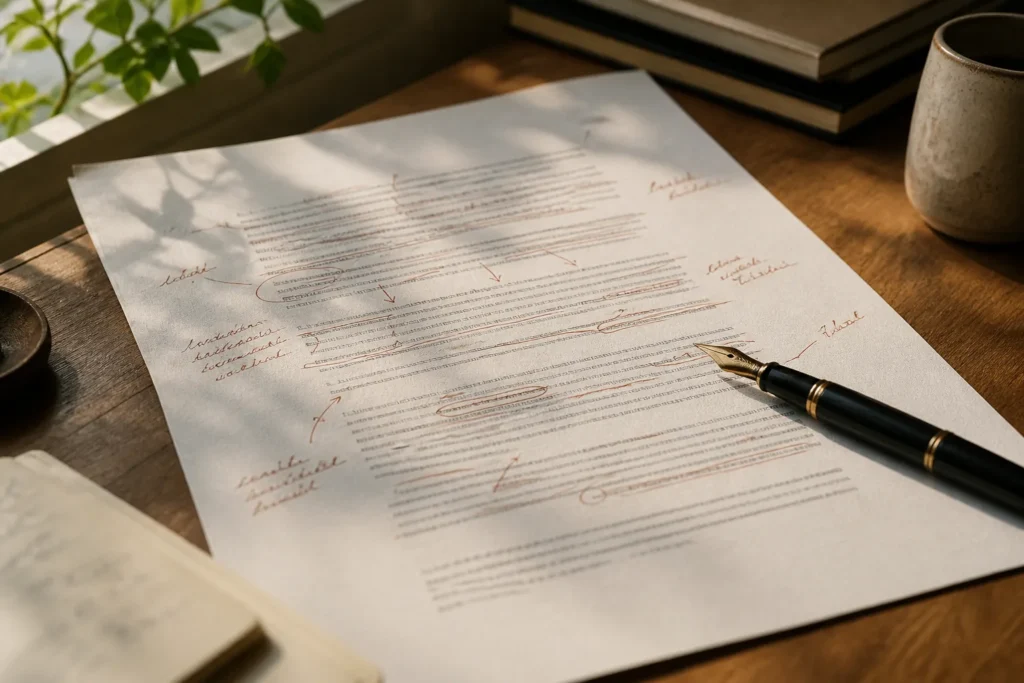
A three-pass editing method protects meaning while improving an AI draft: handle structure first, voice second, and polish last. Begin with a stronger brief, examples of writing you like, a real story or example, and the outcome you want readers to have.
- AI Content Humanization Mistakes That Still Read as Robotic are reduced by adding conversational markers, emotional resonance, and rhythm and flow.
- AI Content Humanization Mistakes That Still Read as Robotic become visible when you read aloud and adjust sentence length, paragraph breaks, punctuation, headings, transitions, and signposting.
- AI Content Humanization Mistakes That Still Read as Robotic can be introduced by polishing away quote texture, hesitation, uncertainty, contradiction, or context. Preserve those qualities when they carry meaning.
In technical or regulated writing, natural language must remain precise and consistent because over-softening can introduce ambiguity.
How can you decide which parts of an AI draft to rewrite and which to keep?
AI output is best treated as a starting point for structure or ideation, then refined for nuance, accuracy, tone, and audience sensitivity. Keeping useful structure while targeting weak passages is more controlled than rewriting every sentence without guidance.
AI Content Humanization Mistakes That Still Read as Robotic deserve attention when phrasing is predictable, wording is generic, patterns repeat, transitions are weak, or the draft misses the intended voice.
AI Content Humanization Mistakes That Still Read as Robotic are a reason for targeted revision, not automatic deletion. AI Content Humanization Mistakes That Still Read as Robotic can often be addressed with two or three passes on specific weak passages, followed by revision of only sentences that remain problematic after review.
Use deletion as a final editorial test: one source recommends cutting 30% after editing because the removed material is where the machine remains. The supplied evidence contains no rates or turnaround times for editing services, so those figures are unknown.

What risks come from adding invented personal anecdotes, forced slang, or deliberate errors to make content seem human?
Invented personal anecdotes can weaken storytelling and credibility because AI cannot supply human insight or lived experience. Use genuine expertise, original examples, and verifiable experience instead of fabricating a personal story.
AI Content Humanization Mistakes That Still Read as Robotic aren't fixed by forced slang. AI Content Humanization Mistakes That Still Read as Robotic can instead become inconsistent when conversational phrasing turns into casual language that breaks the piece’s tone.
AI Content Humanization Mistakes That Still Read as Robotic may also worsen when every sentence is made novel, because too much novelty can make writing chaotic rather than human. Deliberate errors are not supported here as a safe method; preserve meaningful hesitation and uncertainty without manufacturing them.
Detector bias is also a fairness concern: mixed writing may be flagged because detectors assess mathematical consistency rather than intent. The supplied evidence does not establish a broader privacy or disclosure standard for AI-assisted content.
How should you fact-check and adapt humanized AI content for its target audience before publishing?
AI content should not be published without human review, and human review should cover both factual reliability and audience fit. A practical sequence is to flag claims, verify them against primary sources, cross-reference them, and seek expert review for specialized material.
- AI Content Humanization Mistakes That Still Read as Robotic can distract from hallucinations or misinformation, so verify data, statistics, references, quote attribution, quote context, dates, names, events, and every confident claim AI presents.
- AI Content Humanization Mistakes That Still Read as Robotic are easier to catch when vocabulary matches the reader’s job role, experience level, goals, intent, and desired tone.
- AI Content Humanization Mistakes That Still Read as Robotic should be tested with real readers for comprehension and trust, not judged only by detector scores. Detector scores are a rough guide.
Readability, content structure, audience fit, SEO best practices, and any disclosure rule remain publisher- or use-case-dependent here; the supplied evidence establishes no fixed framework.
What features should you look for in an AI humanization tool, and what can such tools fail to fix?
An AI humanization tool should analyze sentence structure, rhythm, repetitive phrasing, readability, factual issues, and style rather than only swap words. Useful controls include writing style and adjustable humanization strength, while human review remains necessary for judgment and accountability.
AI Content Humanization Mistakes That Still Read as Robotic are easier to diagnose when tools expose structure and repetition. AI Content Humanization Mistakes That Still Read as Robotic may remain when a tool changes wording without matching brand voice, audience intent, or strategic messaging.
AI Content Humanization Mistakes That Still Read as Robotic should not be measured by detector scores alone. Detectors can produce false positives and are not foolproof, so treat their output as a revision signal rather than proof of authorship.
A practical human-in-the-loop workflow combines tool-assisted diagnosis, human rewriting, fact-checking, audience review, and a final quality checkpoint. The supplied evidence provides no verified feature or accuracy information for GPTZero, Pangram, or Llama 3, so no product comparison is supported.

| Approach | What it can identify |
|---|---|
| 1bit AI’s content analysis features | repetitive phrases |
| Revision-focused editors | repeated sentence patterns across long drafts |
| Peer review workflows | sections that feel automated or overly polished |
Key Takeaways
- Treat AI output as a starting point, not a finished article.
- Review structure, voice, accuracy, audience fit, formatting, and compliance before publishing.
- Read drafts aloud and revise repeated rhythms, generic wording, and rigid transitions.
- Preserve meaningful hesitation, uncertainty, contradiction, context, and quote texture.
- Use detectors as revision signals, never as proof of authorship.
Frequently Asked Questions
What does humanizing AI-generated content involve?
Why does AI-generated content sound robotic?
Repeated sentence structures, generic vocabulary, formulaic transitions, similar sentence lengths, and a constant neutral tone can make AI-edited content sound robotic.
Can AI detectors prove that content was written by AI?
AI detectors can guide revision, but their scores cannot prove authorship. False positives can affect non-native English, formulaic academic writing, and heavily edited drafts.
How do you humanize AI writing without changing its meaning?
Use three editing passes: structure first, voice second, and polish last. Read the draft aloud, preserve meaningful uncertainty and context, and verify every factual claim before publication.
Should you rewrite an entire AI-generated draft?
Use AI output as a starting point for structure or ideation, then target predictable phrasing, generic wording, weak transitions, and voice mismatches instead of rewriting everything without guidance.