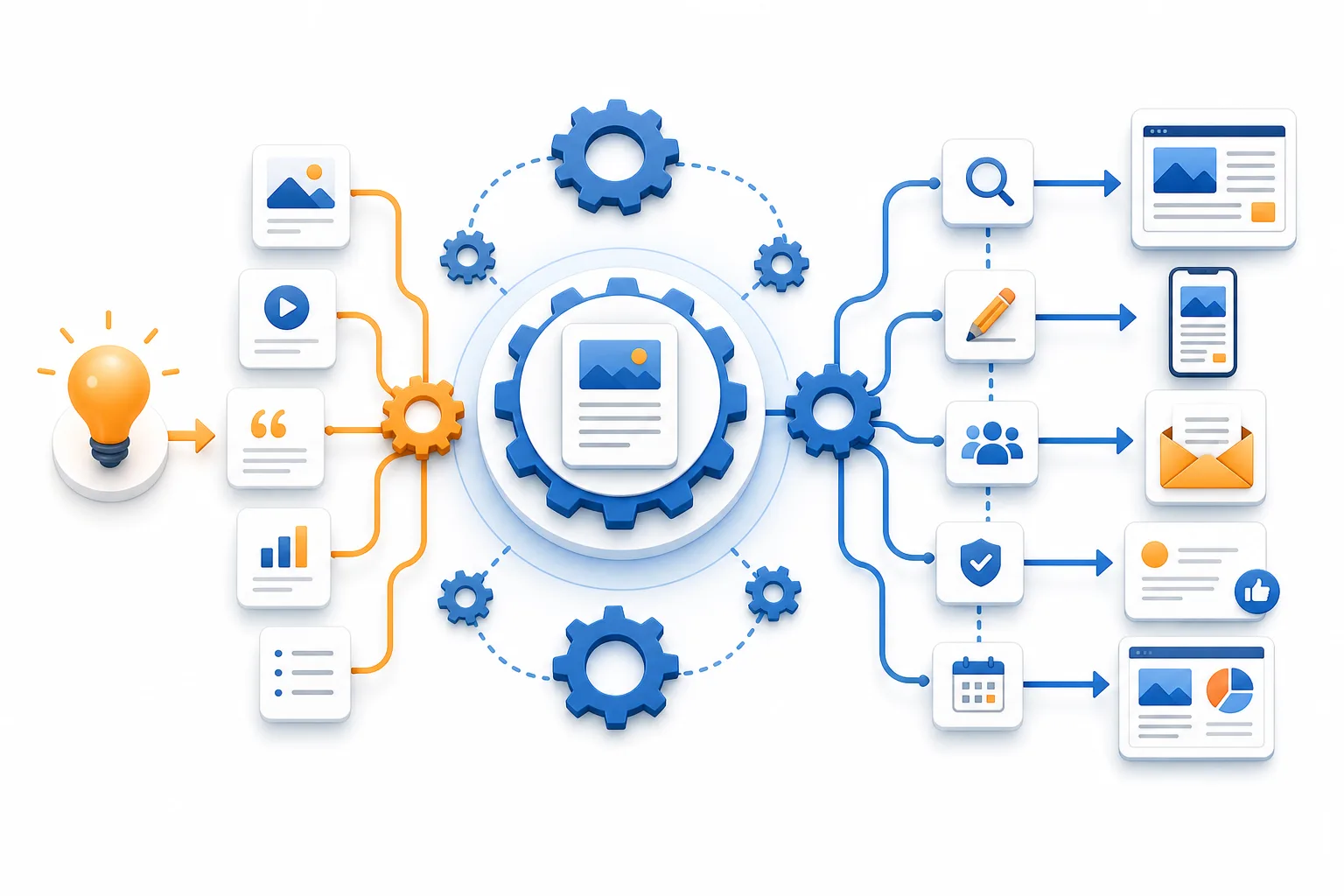
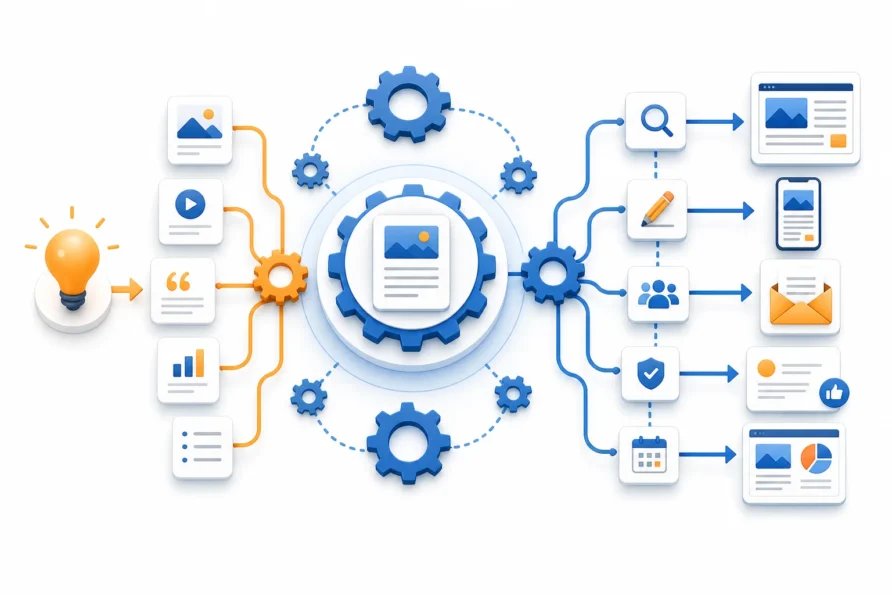
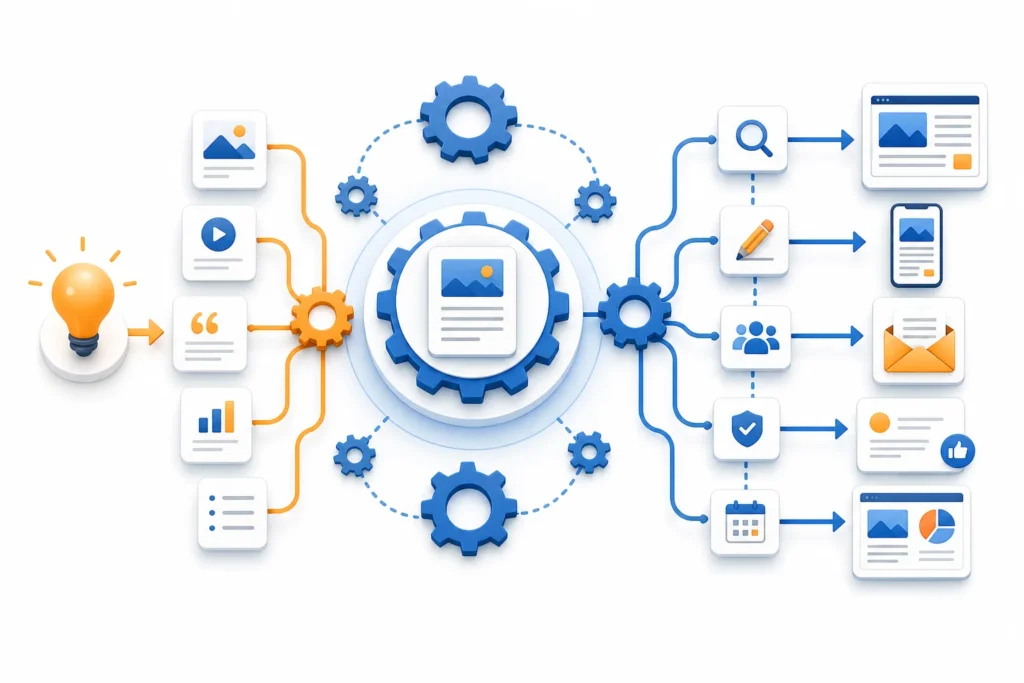
A scalable content workflow helps Content Systems Desk coordinate writers, editors, reviewers, designers, SEO specialists, and publishing teams through defined stages, handoffs, automation, and human approval. A nine-stage path can run from idea capture and prioritization through briefing, drafting, editing, approval, publishing, distribution, and measurement [1]. The system increases output without sacrificing relevance, voice, or performance [2].
- A scalable content workflow uses structured inputs, defined roles, stages, quality checks, and measurement feedback loops [3].
- A documented workflow can include nine stages from idea capture through measurement [1].
- AI-assisted drafts should receive human review before publishing and should not be published as-is [4].
- Lark’s Basic plan is priced at $6 per user per month when billed annually and supports up to users [5].
- Workflow performance measures include monthly writer output, idea-to-post time, and active campaign projects [6].
What is a scalable content workflow, and how does it differ from a process managed by one writer?
A content workflow is a set of pre-established steps for creating, reviewing, and delivering content [7]. A scalable content production process turns those steps into an end-to-end operating system with structured inputs, defined roles, stages, quality checks, and measurement feedback loops [3].
A solo writer may combine planning, briefing, and drafting in one session, with fewer approval stages and more flexibility [1] [5]. A team workflow instead makes handoffs visible: a strategist or coordinator can prepare the input, a writer can draft, an editor can improve the piece, and a reviewer can approve it. Scaling means increasing output sustainably without sacrificing relevance, voice, or performance [2].
For Content Systems Desk, the useful model combines AI-assisted production with professional editing and human expertise. AI can assist with drafting, editing suggestions, metadata, and optimization, but human oversight remains necessary for accuracy and quality [5].
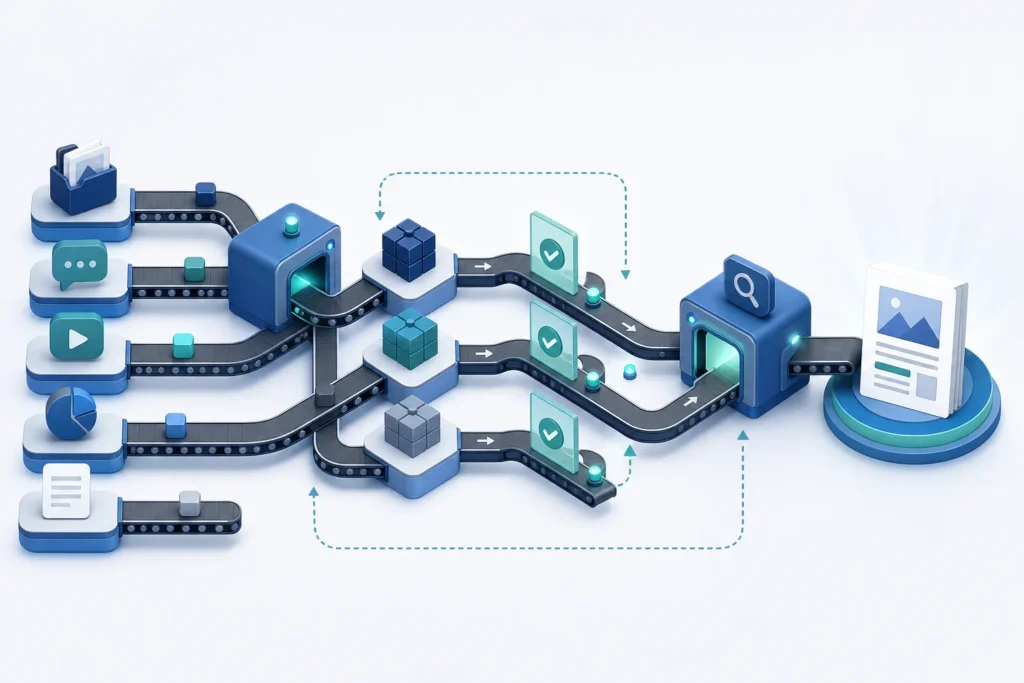

Which stages and handoffs should a content workflow cover from topic selection through publishing and distribution?
A complete content workflow should cover planning, production, and publishing [3]. One useful nine-stage path is idea capture, prioritization, briefing, drafting, editing, approval, publishing, distribution, and measurement [1].
Define the handoffs between research and ideation, drafting and generation, editing and optimization, and distribution and repurposing [8]. Content planning should connect audience needs and business goals with content ideation, keyword mapping, SEO, organic search, and the editorial calendar; brainstorming generates ideas, while keyword mapping connects topics to discoverability and long-term value [5].
Where applicable, add legal or compliance review, brand approval, scheduling, CMS publishing, cross-channel distribution, and post-publish QA [1]. Treat briefs and drafts as content assets: shared access, simultaneous editing, change tracking, and version control help maintain one reliable working record [8].
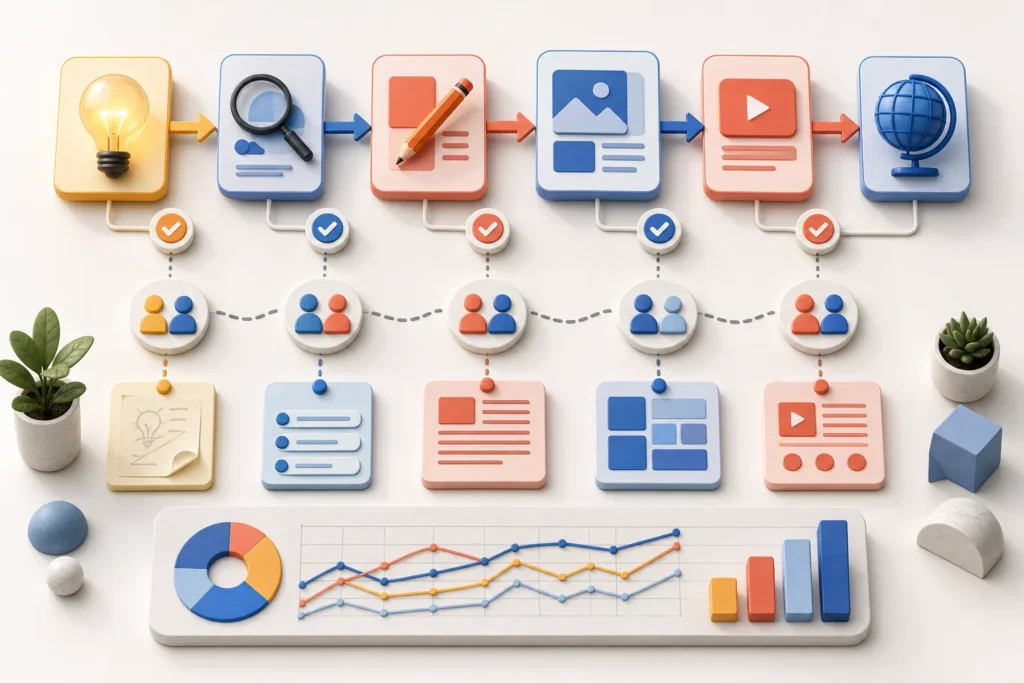
How do task-based and status-based workflows differ, and which is better for coordinating multiple writers and reviewers?
Task-based workflows define what must be done, who is responsible, and when each step is due [7]. That structure suits larger teams and complex projects with multiple stakeholders [7]. You can assign keyword research, drafting, editing, design coordination, review, and final QA as separate tasks, then use project-management software to set deadlines and track statuses [7].
Status-based workflows organize shared progress labels such as “Brief ready,” “Draft in progress,” “In editorial review,” and “Ready to publish” [8]. They may be more efficient for small teams or simple projects that need less detailed direction at each step [7].
Neither model is universally better. Match the model to complexity and interdependencies: task-based workflows suit clearly defined steps, while status-based workflows suit projects with complex interdependencies and multiple contributors [6]. For multiple writers and reviewers, combine clear task ownership with shared content status tracking when both accountability and visibility matter.

What roles, decision rights, and approval steps should be defined to prevent bottlenecks as the team grows?
Content teams should define roles for strategy, ideation, writing, editing, design, distribution, SEO, coordination, legal review, and development where needed [7] [6]. Give every workflow stage one accountable owner and a clear definition of done [1]. A RACI matrix records who is responsible, accountable, consulted, and informed across roles and handoffs [5].
Separate editing from quality assurance: editing improves a piece, while QA enforces standards [3]. When several people can approve a stage, name a final decider so feedback doesn’t create an indefinite queue [1]. Document review cycles, permitted edit rounds, participants, failure modes, escalation criteria, and human override points for AI outputs [3] [5].
Set service-level expectations for review turnaround as an operational standard. The ledger provides no universal turnaround target, so your team must define a target that fits its workload, deadlines, and approval risk.
Which briefs, templates, and quality checklists should be standardized, and where should writers retain flexibility?
Standardize the content brief before production begins. A useful brief includes a working title, summary, suggested angles, format type, audience, and intended outcome [9], then adds the unique angle, required sources, internal links, objectives, tone, structure, and deliverables [1] [5].
Use structured inputs and prompt standardization for AI-assisted work: provide clear constraints, relevant examples, and specific instructions about what to include and avoid [3]. Standardize brand voice, accuracy, compliance, brand alignment, SEO elements, formatting, claim support, scannability, and logic flow through review and self-edit checklists [3] [1].
Leave room for a writer’s personality, expertise, creative approach, and illustrative examples when the core constraints are met [10] [3]. Make briefs and brand guidelines available at the start, with QA checks and review checkpoints throughout [6]. Shared access, change tracking, and version control should make the brief and draft the single source of truth [8].
Which parts of content production can be automated, and which require human review to manage accuracy and brand risks?
Workflow automation is best suited to repetitive administrative work, content templates, status notifications, metadata, auto-tagging, repeated fields, scheduled social posts, repurposing, and distribution [9] [7] [1] [2]. Project tools can also provide automated status tracking, giving teams real-time visibility and reducing repetitive communication [5].
AI and large language models can support article planning, outlines, draft paragraphs, editing, optimization, metadata, and identifying visual opportunities [3] [4]. Human review remains necessary for factual accuracy, claims verification, brand tone, strategic alignment, legal sign-off, insight, judgment, and the final publish decision [3] [1] [8] [2]. AI-assisted drafts should receive editorial review and should not be published as-is [4].
Test an automated workflow with at least to submissions before wider use [9]. Human approval protects content quality, brand voice, SEO judgment, and accuracy while automation reduces repetitive work [9] [6].

What staffing, software, and production-capacity requirements determine the cost of scaling a content workflow?
Production frequency should follow team bandwidth and business goals rather than an assumed publishing quota [7]. Plan staffing around the stages and roles required for strategy, writing, editing, design, SEO, coordination, review, publishing, and distribution [8] [6]. Review current projects and workloads before adding requests so writing-project planning remains realistic and supports workload balancing [11].
Project-management software can assign work, set deadlines, and track content statuses, while file-sharing platforms provide a secure shared space for collaborative drafting [7]. Writers and collaborators need to be capable users of the technologies that support the process [12]. Document the process and train new contributors on briefs, brand voice, handoffs, review, and publishing requirements.
Workflow planning can forecast financial and human resources at each stage [6]. Lark’s Basic plan is priced at $6 per user per month when billed annually and supports up to users [5]. A complete cost model for staffing, outsourcing, software, and production capacity is unknown from the available evidence.
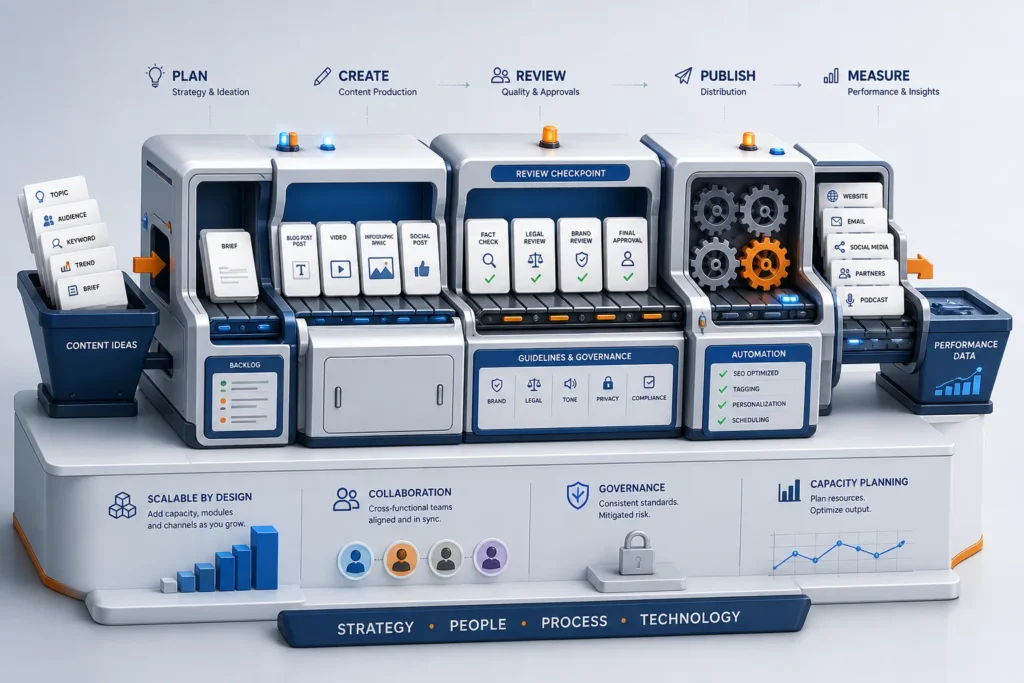
Which metrics can reveal whether the workflow is improving throughput, turnaround time, and content quality?
Measure cycle time with brief-to-publish days, idea-to-post time, approval-cycle time, review turnaround time, and adherence to publishing deadlines [1] [5] [6]. Measure throughput with monthly writer output, content volume per writer, and the number of active projects in a campaign [8] [6]. On-time publish rate adds a scheduling view.
Track revision-cycle count and investigate when content consistently needs more than two revision rounds, because that pattern can indicate a problem with the initial brief or review stage [10]. Measure outcomes through organic traffic, engagement, conversions, traffic, refresh frequency, outcomes per piece, and content reuse rate [1] [5] [3].
Review workflow outputs daily during the first week, make small changes in a 15-minute weekly review, and hold broader quarterly reviews for bottlenecks and solutions [9] [1] [10]. Team adoption and performance at each workflow stage show whether the standardized process is being used and where it needs attention [9] [4].

| Source | Workflow measures stated |
|---|---|
| linkedin.com [9] | how much faster content moves from idea to publication; whether members are usin [9] |
| rewritebar.com [1] | brief-to-publish days, on-time publish rate, approval-cycle time, organic and en [1] |
| larksuite.com [5] | review turnaround time, revision-cycle count, and adherence to publishing deadli [5] |
| brafton.de [6] | monthly writer output, idea-to-post time, and the volume of active projects for [6] |
Key Takeaways
- Give every workflow stage one accountable owner and a clear definition of done [1].
- Use structured briefs, prompt constraints, brand guidance, and publishing checklists to reduce avoidable rework [3] [5].
- Automate repetitive administrative work, but keep accuracy, claims verification, brand tone, legal sign-off, and final publishing human-gated [1].
- Match task-based or status-based coordination to project complexity and contributor interdependencies [6].
- Track cycle time, revision count, throughput, adoption, reuse, and content outcomes, then review the process at daily, weekly, and quarterly intervals [9] [1] [10].
Frequently Asked Questions
Is content creation still worth it in 2026?
The provided evidence doesn’t establish whether content creation remains worthwhile in 2026. It does show that a documented workflow can help teams increase content volume while maintaining consistency, and that performance should be measured through outcomes such as organic traffic, engagement, conversions, and reuse rate [4] [1].
How to scale content creation?
Scale content creation by defining stages, owners, briefs, review checkpoints, automation boundaries, capacity, and performance measures. A scalable workflow uses structured inputs, defined roles, quality checks, and feedback loops rather than relying on one writer’s individual process [3].
What are the steps of workflow?
A practical five-part workflow can cover planning, briefing, production, review and approval, and publishing and distribution. The ledger also describes a nine-stage path: idea capture, prioritization, briefing, drafting, editing, approval, publishing, distribution, and measurement [3] [1].
What are the steps of content creation?
The evidence does not define one universal seven-step content-creation model. One documented collaborative-writing model identifies brainstorming, conceptualizing, outlining, drafting, reviewing, revising, and editing as seven core activities [12].
Sources
- Content Creation Workflow Blueprint from Idea to Publish
- Content Scaling: Supercharge Your Content Creation with AI
- AI Content Workflow: A Scalable System for Marketers (2026-02-16)
- AI Content Marketing Workflow: A Lightning-Fast Guide (2023-06-03)
- How to Build an Efficient Content Creation Workflow
- How To Build a Content Creation Workflow in Steps (2026-03-18)
- How to build a content creation workflow that works (2024-07-24)
- AI Writing Workflow for Content Teams (2026-04-17)
- The Complete Guide to Automating Your Content Creation Workflow (2025-11-18)
- A Better Content Creation Workflow (2025-07-29)
- Demystifying Collaborative Writing: Two Pre-Strategy Steps for Coauthors (2022-03-23)
- Collaborative writing: Strategies and activities for writing productively together