

Content repurposing means adapting existing content into channel-specific formats, while unchanged reposting repeats the same asset. Canva and Buffer are cited for visual adaptation and scheduling, and one reported “1 = rule” expands a winning insight into assets. Content Repurposing Mistakes That Waste Your Best Material are mainly caused by ignoring audience, platform, measurement, and review needs.
- Content repurposing adapts existing content across formats and platforms.
- A reported 94% of marketers repurpose content across channels and formats.
- One winning insight was described as becoming assets under the “1 = rule”.
- Turning a carousel into an infographic was reported to take minutes.
- Canva is recommended for visual adaptations and Buffer for social media scheduling.
What does content repurposing mean, and how is it different from reposting the same asset unchanged?
Content repurposing means adapting existing content across different formats and platforms, while unchanged reposting simply repeats the same asset. Content Repurposing Mistakes That Waste Your Best Material begins with confusing those two activities. Content Repurposing Mistakes That Waste Your Best Material are easier to avoid when you treat adaptation as a deliberate editorial process. The phrase Content Repurposing Mistakes That Waste Your Best Material describes the waste created when distribution replaces useful transformation.
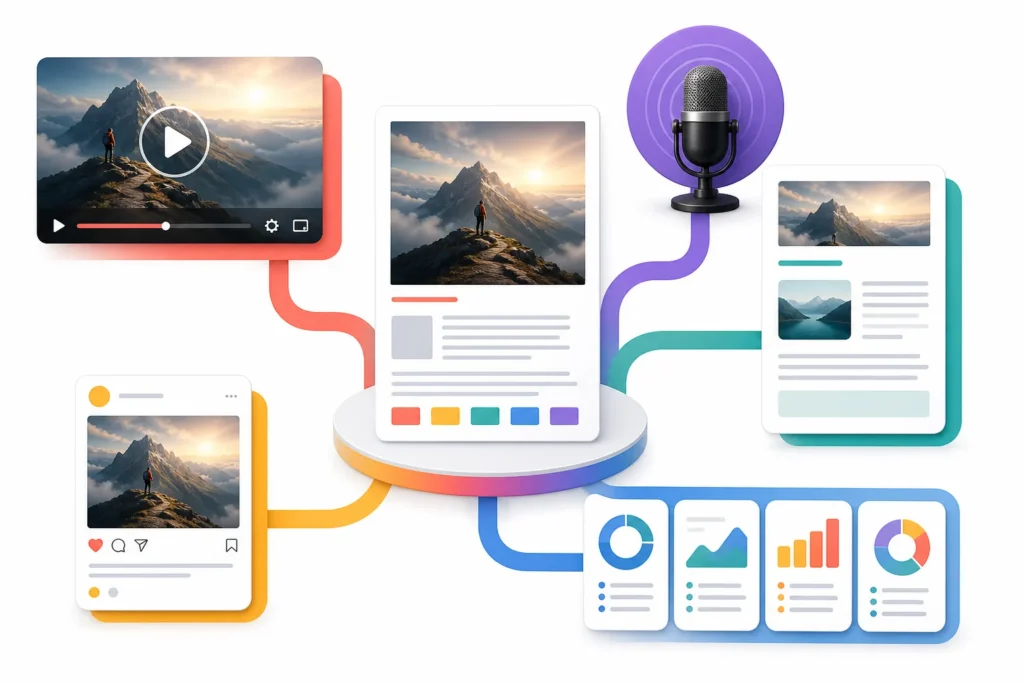
Strategic repurposing multiplies one content asset into many assets. Pierre Herubel describes an “extend” process as an alternative to a “cut” process, which frames repurposing as expanding an idea rather than merely trimming it.
The available evidence supports treating the original asset as a central source for a content marketing strategy and content lifecycle, but it doesn’t provide formal definitions of “master content” or “content lifecycle.” Even so, the scale is clear: 94% of marketers reportedly repurpose content across channels and formats.
Which performance metrics and content characteristics should you use to decide what is worth repurposing?
Choose repurposing candidates by combining a defined campaign objective, measurement plan, historical performance, and audience evidence before production begins. Content Repurposing Mistakes That Waste Your Best Material often start with selecting a topic only because it is convenient. Content Repurposing Mistakes That Waste Your Best Material also result when performance is treated as the only test. The phrase Content Repurposing Mistakes That Waste Your Best Material is a useful reminder to assess both results and relevance.
Review older material that performed well, then update it with new information or trends. Check audience needs through social listening, polls, and keyword analysis. Also consider what your audience cares about, where people spend time online, and which content they engage with.
Performance alone can mislead. Margaret Magnarelli says Monster’s analytics showed that its audience wanted job-search help rather than macro labor-market trends. That evidence supports selecting evergreen topics, key insights, and content ideas only when they match demonstrated audience needs or performance; the ledger supplies no separate test for “evergreen” content.

What are the Content Repurposing Mistakes That Waste Your Best Material?
Posting identical content everywhere wastes strong material because different networks have different cultures, users, behaviours, and formats. Content Repurposing Mistakes That Waste Your Best Material include cross-posting without adapting the platform or audience. Content Repurposing Mistakes That Waste Your Best Material also include treating one-size-fits-all social content as a distribution strategy. Avoiding Content Repurposing Mistakes That Waste Your Best Material requires editorial decisions for every channel.
- Unchanged posts may suit no network particularly well because social platforms reward different styles, rhythms, and engagement approaches.
- Content without platform context can appear tone-deaf, and a poorly timed post can be screenshotted and reshared almost immediately.
- Inconsistent messaging and an unclear brand voice can confuse followers and weaken brand identity.
- Ignoring comments, messages, and feedback can damage follower relationships and reduce interest.
Publishing more isn’t automatically better: Jason Schemmel says publishing less while focusing on quality and audience connection made his numbers rise. Check original performance before adapting, track which versions perform best, and leverage one quality asset rather than producing many mediocre ones.

What step-by-step process turns one source asset into channel-specific versions while preserving its core message?
A planned repurposing system turns one strong source asset into channel-specific versions without losing its central message. Content Repurposing Mistakes That Waste Your Best Material happen when adaptation begins after production without a destination in mind. Content Repurposing Mistakes That Waste Your Best Material are less likely when you map formats before writing. The phrase Content Repurposing Mistakes That Waste Your Best Material also covers losing the source’s key insight during expansion.
- Choose a strong source asset and identify its central message and key insights.
- Map versions to audience needs and buyer-journey stages: a social post can support awareness, a landing page consideration, and a case study decision.
- Adapt the format, then review whether every version preserves the intended message.
- Schedule each version in a content calendar and measure the results; calendars help plan ahead and scheduling tools support consistency.
Herubel’s “1 = rule” expands one winning insight into a carousel, infographic, newsletter, blog article, video, five short videos, and five additional posts. His master-content process can support a three-month marketing campaign from one central content piece. Blog subheadings can become video talking points, with bullet points beneath each heading to keep the recording on track.

What formats and platform specifications should you account for when adapting a single piece of content across channels?
Format selection should follow audience preference and platform expectations: some people prefer in-depth blogs, while others prefer short infographics. Content Repurposing Mistakes That Waste Your Best Material include forcing one format into every channel. Content Repurposing Mistakes That Waste Your Best Material also arise when native features and audience expectations are ignored. The phrase Content Repurposing Mistakes That Waste Your Best Material is especially relevant to short-form video and social distribution.
A blog can become social snippets, statistic-led posts, takeaways, follow-ups, guest posts, infographics, video scripts, signup offers, ebooks, and presentations. A blog’s key points can also become an infographic for visual audiences on platforms such as Pinterest or LinkedIn. LinkedIn carousels are multi-slide visual posts suited to step-by-step processes and lists.
Video specifications differ. A video accompanying a blog post may be to seconds, general Facebook guidance is 60–90 seconds, and Instagram Stories has a 15-second video limit; the source describes IGTV videos as ranging from a few minutes to an hour. Transcripts can support search visibility and sound-off viewing, while native uploads are recommended instead of sharing video links. Tailor tone, stories, live sessions, hashtags, captions, transcripts, alt text, readable design, and permissions where relevant; the evidence directly supports platform tailoring and native features, but not separate accessibility or rights requirements.

How do the time and production costs of adapting content compare with creating new material or reposting it unchanged?
Repurposing can require less conceptualising and research than creating something entirely new because it reuses existing work. Content Repurposing Mistakes That Waste Your Best Material include reposting without adding value. Content Repurposing Mistakes That Waste Your Best Material also include assuming every adaptation has the same production cost. The phrase Content Repurposing Mistakes That Waste Your Best Material points to a resource problem, not a fixed price.
Andy Crestodina says updating an older article can often produce better results than writing a new one. One reported example says turning a carousel into an infographic takes minutes. Another system turns four original ideas into at least content pieces, while one estimate puts repurposed writing at about one hour per week.
| Approach | What the evidence supports | Monetary cost |
|---|---|---|
| Unchanged reposting | Repeats the same asset and may fail to fit the channel or audience | Unknown |
| Adapted repurposing | Reuses existing work and may save time and resources | Unknown |
| Creating new material | Requires new conceptualising and research | Unknown |
No complete cost model or price range is available in the evidence. Spinutech reports potential gains in traffic, engagement, SEO value, time, and resources, but those outcomes aren’t guaranteed.
Which metrics show whether repurposed content is generating reach, engagement, and conversions on each channel?
Measure each adapted asset against a channel-specific plan covering reach, engagement, conversions, impressions, click-through rates, and audience behaviour. Content Repurposing Mistakes That Waste Your Best Material include publishing versions without defining success. Content Repurposing Mistakes That Waste Your Best Material also include judging every channel by the same KPI. The phrase Content Repurposing Mistakes That Waste Your Best Material is avoidable when each version has a comparison point.
| Channel | Adapted asset | Primary KPI | Supporting KPI | Comparison point |
|---|---|---|---|---|
| Social channel | Social post or carousel | Reach | Engagement and impressions | Original asset |
| Video channel | Short-form video | Audience behaviour | Engagement and reach | Original content |
| Conversion channel | Landing page or signup offer | Conversions | Click-through rate | Original content |
The ledger provides no channel-specific benchmark values, so compare every adapted version with the original and track which repurposed pieces perform best. Success can mature from shareability to content quality and distribution, then to lead generation and social selling. Social listening can add mentions, competitor activity, and emerging trends. Attribution remains a measurement question here because no attribution methodology is provided.
Which content repurposing tools can automate adaptation and scheduling, and how do their features and prices compare?
Canva is recommended for creating carousels and image versions of text posts, while Buffer is recommended for social media scheduling. Content Repurposing Mistakes That Waste Your Best Material include buying or configuring tools before defining the workflow. Content Repurposing Mistakes That Waste Your Best Material also include expecting automation to replace editorial judgement. The phrase Content Repurposing Mistakes That Waste Your Best Material matters when choosing between visual adaptation and distribution needs.
| Tool or tool category | Visual adaptation | Scheduling | Analytics | Platform distribution |
|---|---|---|---|---|
| Canva | Carousels and image versions of text posts | Not specified | Not specified | Not specified |
| Buffer | Not specified | Social media scheduling | Not specified | Not specified |
| Social media management tools | Not specified | Scheduling can support consistency | Can track performance over time | Can help balance paid and organic efforts |
Plan posts with a content calendar and schedule them regularly; one recommendation is to aim for 2–3 posts a week. Prices, plan limits, AI adaptation features, and current integrations are unknown from the available evidence. Content Systems Desk’s stated focus includes AI-assisted editing, fact-checking, human review, content repurposing, and automated content workflows; the ledger doesn’t provide unsupported product claims about those capabilities.

| Video format | Length |
|---|---|
| Facebook video | 60–90 seconds |
| Instagram Stories video | 15-second video limit |
| IGTV video | a few minutes to an hour |
| Video accompanying a blog post | 30- to 60-second video |
| Approach | What the evidence supports | Monetary cost |
|---|---|---|
| Unchanged reposting | Repeats the same asset and may fail to fit the channel or audience | Unknown |
| Adapted repurposing | Reuses existing work and may save time and resources | Unknown |
| Creating new material | Requires new conceptualising and research | Unknown |
Key Takeaways
- Define the campaign objective and measurement approach before production.
- Choose source material using both historical performance and audience evidence.
- Adapt format, tone, and native features for each platform instead of cross-posting unchanged.
- Compare every adapted asset with the original and track the strongest versions.
- Treat tool prices, plan limits, AI features, and integrations as unknown unless verified.
Frequently Asked Questions
What are the C's of content creation?
The available evidence doesn’t define five specific “C’s” of content creation. It does support setting an objective, measuring performance, using audience feedback, and adapting content to platforms.
What are some common marketing mistakes?
Common mistakes include posting identical content across platforms, ignoring audience feedback, using inconsistent messaging, and repurposing without checking the original performance.
What does it mean to repurpose content?
Content repurposing means adapting existing content into different formats for different platforms rather than reposting the same asset unchanged. The approach can strategically multiply one piece into many assets.
What are the main types of content?
The available evidence doesn’t list seven main types of content. It does identify formats including blog articles, social posts, infographics, video scripts, signup offers, ebooks, presentations, and newsletters.