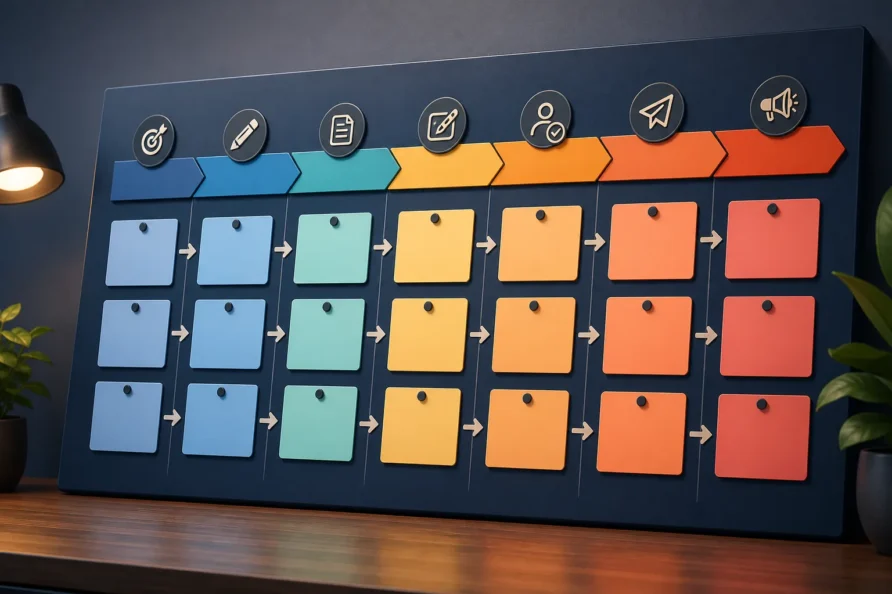

How to Repurpose One Piece of Content into a Full Month means adapting one pillar post, video, or podcast episode into channel-specific blog spin-offs, social posts, emails, visuals, and resources. One example from a pillar post includes 8–12 social posts, 2–4 videos or reels, four blog spin-offs, one email campaign, and one lead-generating resource.
- A pillar-post example includes four blog spin-offs, 8–12 social posts, 2–4 videos or reels, one email campaign, and one lead-generating resource.
- One YouTube video can become five to ten social media posts through clips, quotes, or standalone concepts.
- A comprehensive blog post can fuel a five- to seven-email sequence when each email adds exclusive context.
- A digital asset inventory can be a simple Excel worksheet or a Notion board.
- Only about 10% of an audience may see a social post the first time it is shared.
How to Repurpose One Piece of Content into a Full Month: What does it mean to repurpose a piece of content, and how is it different from reposting it?
Content repurposing means using something you’ve already created in a new way. How to Repurpose One Piece of Content into a Full Month starts with adaptation, not duplication: you adjust the source message for different formats, platforms, and audience preferences instead of copying and pasting it.
Reposting keeps the same asset largely intact, while repurposing translates a core insight into a form suited to each audience and platform. That distinction matters for a content marketing strategy spanning website content, organic social channels, email newsletters, and visual assets. How to Repurpose One Piece of Content into a Full Month can therefore mean treating a published blog post, video, or podcast episode as source material for channel-specific derivatives.
The hub-and-spoke model is a useful planning metaphor: one central piece supplies ideas, while each channel receives a version shaped for its audience. How to Repurpose One Piece of Content into a Full Month is not mechanical duplication; it’s coordinated translation across your content workflow.


How do you choose a source piece with enough useful ideas to support a month of content?
A strong source piece is usually a pillar post: an in-depth, evergreen work about a core audience topic with multiple subtopics, takeaways, or steps. For How to Repurpose One Piece of Content into a Full Month, choose material that solves a core audience problem, performs well, has a clear structure, and is timeless or easy to update.
Use traffic, search-intent alignment, and conversion data to identify high-value website content before you commit production time. Then break the candidate into statistics, quotes, frameworks, how-to steps, case studies, and conclusions. If the source doesn’t contain distinct ideas, How to Repurpose One Piece of Content into a Full Month becomes a forced exercise rather than a useful system.
Keep a content catalog with each blog post’s title, topic, live URL, resources, and lead magnets. A simple Excel worksheet or Notion board can serve as the digital asset inventory. Blog posts, video content, YouTube, podcast episodes, webinars, recorded workshops, how-to guides, and research reports can all work when they contain enough separate ideas. How to Repurpose One Piece of Content into a Full Month begins with evidence that the source has range.

How many posts and content formats can one source piece realistically produce in a month?
One source can produce a substantial set of derivatives, but the available figures are examples and recommendations rather than a universal quota. A pillar-post example includes four blog spin-offs, 8–12 social posts, 2–4 videos or reels, one email campaign, and one lead-generating resource. How to Repurpose One Piece of Content into a Full Month should therefore be treated as a planning exercise, not a promise of identical output.
Another recommendation is to aim for at least distinct content assets from each flagship blog post. One YouTube video is described as producing five to ten social posts through clips, quotes, or standalone concepts. How to Repurpose One Piece of Content into a Full Month may also follow a video mix of five to six shorts, two carousels, three quote cards, two text posts, one newsletter section, and four comment answers.
A comprehensive blog post can support a five- to seven-email sequence when every email adds exclusive context. How to Repurpose One Piece of Content into a Full Month works best when you select only the formats your source and audience can genuinely support.

What steps turn a blog post, video, or podcast episode into platform-specific social posts, emails, and visual assets?
An extraction document gives your content workflow a practical starting point: copy the source into a Google Doc or notes app, then map each idea to a possible format. How to Repurpose One Piece of Content into a Full Month becomes easier when every derivative has a job. A five-step video argument, for example, can become a five-card carousel.
Adapt each clip for its platform by changing the first frame, adding framing text, or moving the in-point. Short-form video needs a context-free hook and captions; one guide recommends a two-second hook, one claim or data point, two or three examples, and a call to action. How to Repurpose One Piece of Content into a Full Month can also turn a pillar post into a curated email summary, personal take, condensed version, or freebie.
Consider infographics, Stories graphics, carousels, podcast adaptations, blog conversions, and video walkthroughs. Add captions, transcripts, readable graphics, and descriptions of essential visual information when adapting video to audio. AI can assist with conversion, but human review is necessary because drafts may be inaccurate or robotic. How to Repurpose One Piece of Content into a Full Month still needs editorial judgment.
How should you schedule the repurposed pieces across a month without repeating the same message too often?
A 30-day calendar can place 8–12 social posts across two to four priority platforms instead of spreading effort across every channel. How to Repurpose One Piece of Content into a Full Month works better when you rotate angles from the same pillar post rather than repeat identical copy.
A practical sequence might begin with source promotion, move through educational derivatives, add visual assets and email content, and finish with a conversion-focused resource. Keep the recognizable brand voice and message while changing the format and framing. How to Repurpose One Piece of Content into a Full Month doesn’t require avoiding every repeated idea: expressing one useful idea in different formats on different platforms differs from posting the same clip repeatedly on the same surface.
Consider resurfacing carefully because one estimate says only about 10% of an audience may see a social post the first time. Organic social channels, email newsletters, website content, and longer-lived Pinterest posts can play different scheduling roles; Pinterest posts may live for years if done correctly. How to Repurpose One Piece of Content into a Full Month should give each derivative enough space to be noticed.
What tools and production time are needed to turn one source piece into a month of content?
A simple Excel asset inventory or Notion board can organize the source, derivatives, status, and review tasks. How to Repurpose One Piece of Content into a Full Month needs a visible production queue more than a complicated technology stack. Canva, Figma, and Adobe Express are named for visual assets, while CapCut, Descript, and Canva are described as beginner-friendly video tools.
Descript can help you find standalone moments by letting you read a video transcript. Transcript support can also help with old podcast episodes, including downloadable episode transcripts where the source provides them. How to Repurpose One Piece of Content into a Full Month can move faster when saved AI prompts reduce format-conversion time from hours to minutes.
Connect a blog CMS with social-scheduling and email tools so published material can queue drafts for human review. The available evidence doesn’t provide a universal production-time estimate. How to Repurpose One Piece of Content into a Full Month still requires professional editing, fact-checking, brand judgment, and audience-aware writing; AI and automation support that work rather than replace it.


What common repurposing mistakes reduce engagement, and how can you avoid them?
Random clip cutting is a common quality problem because equal time intervals can produce excerpts that depend on missing context and become incoherent alone. How to Repurpose One Piece of Content into a Full Month should rank candidate clips by the strength of their first three seconds, not only by the strength of the underlying idea.
AI-generated drafts also need human review because they can contain inaccuracies or sound robotic. Refresh, fact-check, and update older source content before republishing so it remains relevant. How to Repurpose One Piece of Content into a Full Month should preserve a consistent brand voice while changing the format and framing for each audience.
When spoken material becomes a blog post, use headers, sub-headers, bullet points, lists, and images instead of leaving a wall of text. Add captions and transcripts, use readable graphic design, and describe essential visual information. How to Repurpose One Piece of Content into a Full Month is strongest when accessibility and editorial clarity are treated as production requirements.

Which performance metrics should you track to decide what to repurpose or improve next month?
Track each repurposed format separately, including website traffic, email signups, and LinkedIn connection requests where those analytics are available. How to Repurpose One Piece of Content into a Full Month needs a measurement framework that separates reach, engagement, traffic, conversions, and attribution rather than treating every reaction as equal.
Compare formats directly: reels may gain traction while quote graphics drive traffic. Comments and a video-retention graph can identify lines worth turning into quote cards or future derivatives. Immediate reactions and comments can also show what worked and what didn’t. How to Repurpose One Piece of Content into a Full Month should therefore produce learning, not merely more publishing.
End each month by asking what went well, what resonated, and what merits another round. Use available analytics to make adjustments where needed. How to Repurpose One Piece of Content into a Full Month is the kind of workflow Content Systems Desk can support by combining AI-assisted conversion with editing, fact-checking, human expertise, SEO content, email content, and brand-appropriate repurposing.

| Source | Input content | Repurposing output |
|---|---|---|
| setfirecreative.com | one pillar post | four blog spin-offs, 8–12 social posts, 2–4 videos or reels, one email campaign… |
| marketingbyshelby.com | one YouTube video | five to ten social media posts |
| storyflow.so | one video | five to six shorts, two carousels, three quote cards, two text posts, a… |
| digitalapplied.com | every flagship blog post | at least distinct content assets |
| Input content | Example output |
|---|---|
| One pillar post | Four blog spin-offs; 8–12 social posts; 2–4 videos or reels; one email campaign; one lead-generating resource |
| One YouTube video | Five to ten social media posts |
| One video | Five to six shorts; two carousels; three quote cards; two text posts; one newsletter section; four comment answers |
| Every flagship blog post | At least distinct content assets |
Key Takeaways
- Choose a structured, evergreen source that solves a core audience problem and contains multiple distinct ideas.
- Extract statistics, quotes, frameworks, steps, case studies, and conclusions before choosing derivative formats.
- Adapt hooks, captions, framing, length, and calls to action for each platform instead of copying the source.
- Schedule 8–12 social posts across two to four priority platforms and rotate different angles.
- Review format-level analytics monthly so the next round reflects audience response and available conversion data.
Frequently Asked Questions
What is the 5-3-1 rule on social media?
The claim ledger doesn’t define a 5-3-1 rule for social media, so its meaning is unknown here.
What is the 3-2-1 rule on Instagram?
The claim ledger doesn’t define a 3-2-1 rule for Instagram, so its meaning is unknown here.
Is content creation still worth it in 2026?
Whether content creation is still worth it in isn’t established by the claim ledger. The available evidence describes repurposing methods and output examples, not a universal business case.
What is the rule for social media?
The claim ledger doesn’t define the rule for social media, so its meaning is unknown here.