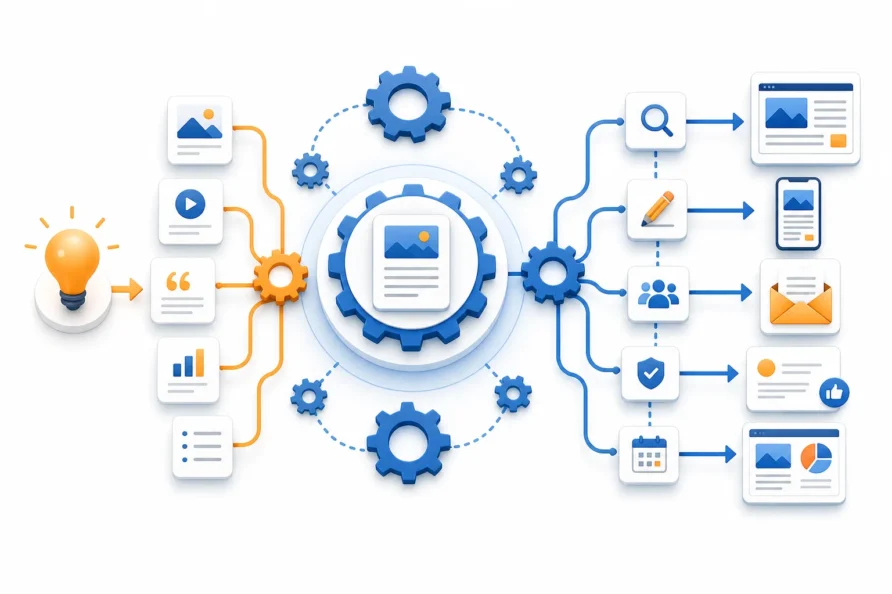

How to Build a Content Workflow That Scales Past One Writer means mapping stages from strategy and audience research through briefs, drafting, editing, design, approval, publishing, promotion, and measurement, then assigning clear owners and review rules. A RACI matrix, one final decision owner per asset, reusable templates, batching, and human review of AI-assisted drafts create a repeatable system for growing teams.
- A content creation workflow defines the steps, responsibilities, timelines, and quality standards that move content from planning through distribution.
- Lark’s Basic plan is listed at $6 per user per month when billed annually.
- ONES Project’s free plan covers users, and paid plans start at $6 per user per month.
- Wrike’s Team plan is listed at $9.80 per user per month and includes custom workflows and proofing.
- Review turnaround time, revision-cycle count, and publishing-deadline adherence are workflow-efficiency measures.
How to Build a Content Workflow That Scales Past One Writer
How to Build a Content Workflow That Scales Past One Writer starts by defining the workflow as the steps, responsibilities, timelines, and quality standards that move content from planning through distribution.
How to Build a Content Workflow That Scales Past One Writer should connect content marketing strategy, audience research, content planning, content ideation, production, approvals, publishing, content promotion, and performance tracking.
How to Build a Content Workflow That Scales Past One Writer becomes practical when you map brainstorming, briefs, writing and drafting, editing, design and asset production, publishing, and promotion as visible workflow stages. Breaking the process into steps also shows which tasks can be outsourced without compromising quality.
For Content Systems Desk, that structure supports AI-assisted content creation, professional editing, fact-checking, humanizing drafts, long-form content, SEO content, email content, and content repurposing without treating automation as a substitute for judgment.

How should a team divide content roles and approval responsibilities when moving beyond one writer?
How to Build a Content Workflow That Scales Past One Writer requires explicit roles for writers, editors, AI tools, graphic designers, virtual assistants, content managers, subject matter experts, stakeholders, channel owners, and final approvers.
How to Build a Content Workflow That Scales Past One Writer is easier to manage with a RACI matrix that identifies who is responsible, accountable, consulted, and informed at each handoff. A content manager can lead the editorial calendar while freelance writers create copy and the manager proofreads and publishes it.
How to Build a Content Workflow That Scales Past One Writer should assign one named final decision owner to each asset; that person’s approval releases the asset for publication. Keep feedback separate from approval, apply approval to a specific file version, and archive earlier iterations through version control.
Documenting task ownership prevents a stakeholder’s comment from being mistaken for a publishing decision. The ledger does not identify a universal staffing ratio, so assign responsibility according to your actual workload and expertise.
What briefs, templates, calendar fields, and workflow tools are needed to make assignments repeatable, and what costs should a team budget for them?
How to Build a Content Workflow That Scales Past One Writer needs a content brief covering objectives, audience needs, tone, structure, deliverables, primary and secondary keywords, key points, and a proposed outline.
How to Build a Content Workflow That Scales Past One Writer should use reusable templates with titles, subtitles, introductions, main points, data, examples or case studies, paragraphs, and conclusions. Calendar fields should include date, channel, content, publishing time, title, and keywords.
How to Build a Content Workflow That Scales Past One Writer benefits from project-management features for task assignment, deadlines, stage tracking, custom fields, automation, forms, proofing, and approvals. Notion can hold SOPs and content calendars, Trello’s free plan includes up to boards, unlimited cards, and basic automation, CoSchedule supports workflow, calendar, scheduling, and publishing, and Editorial Calendar for WordPress lets teams schedule posts and see whether they are drafts or scheduled.
Listed prices vary: Lark’s Basic plan is $6 per user per month when billed annually, ONES Project has a free plan for users with paid plans from $6 per user per month, and Wrike’s Team plan is $9.80 per user per month. Budget separately for training, migration, productivity loss, and recurring platform fees.

How can a team plan and batch work to increase content output without creating bottlenecks between writers, editors, and approvers?
How to Build a Content Workflow That Scales Past One Writer uses batching to group similar tasks, such as researching and outlining several articles before drafting them.
How to Build a Content Workflow That Scales Past One Writer can follow a weekly pattern: research and outlines on Monday, drafting on Tuesday and Wednesday, editing and formatting on Thursday, and scheduling and promotion planning on Friday.
How to Build a Content Workflow That Scales Past One Writer needs review limits and deliberate sequencing. Review structure before polish, avoid parallel reviews that create conflicting instructions, and define approval layers to reduce delays.
As production increases, appoint a lead to manage the workflow and use automation for status transitions, assignments, and notifications. Capacity planning should include backlog prioritization, sprint planning, capacity planning, and retrospectives. A single review space supports asynchronous feedback, version control, and fewer repetitive comments.

Which content tasks are best suited to freelancers, in-house staff, or AI, and what quality or coordination trade-offs does each option bring?
How to Build a Content Workflow That Scales Past One Writer can use freelance SEO copywriters for blogs and landing pages that use SEO keywords. Evaluate candidates through a limited paid trial or sample post to assess professionalism and their response to feedback.
How to Build a Content Workflow That Scales Past One Writer should account for the trade-off between writing services and direct hiring: services cost more per piece, while direct hiring costs less per piece but leaves hiring and management work with your team.
How to Build a Content Workflow That Scales Past One Writer keeps calendars, proofreading, publishing, fact-checking, brand voice, readability, and rich media with in-house managers or editors where those responsibilities require close coordination.
AI can support brainstorming, angles, headlines, outlines, first drafts, keyword research, research summaries, metadata, and social posts, but the output should be treated as a rough draft. A hybrid workflow uses people for insight, fact verification, and brand voice; human editing remains necessary because AI can produce inaccurate claims. Published posts can also be repurposed into social content, while AI can identify outdated statistics or suggest sections for older posts.

What review steps and standards help maintain accuracy, brand voice, and compliance as more people produce content?
How to Build a Content Workflow That Scales Past One Writer needs a style guide covering tone of voice, vocabulary, grammar, formatting, visual guidance, and calls to action.
How to Build a Content Workflow That Scales Past One Writer should give new contributors brand examples, guidelines, templates, a one-page intake brief, and a short walkthrough of the intake form. That onboarding system makes the brand voice and task requirements available before drafting begins.
How to Build a Content Workflow That Scales Past One Writer should sequence self-editing, grammar checking, fresh-eyes review, subject matter expert review, stakeholder review, compliance review, final sign-off, and publication. Review claims, statistics, originality, accuracy, readability, errors, and brand alignment, especially in AI-generated content.
Classify incoming assets by risk: high-risk assets go through the full review workflow, while low-risk assets can receive a single reviewer sign-off. Intake should require an approved brief, brand-guideline reference, asset specifications, legal disclosures, deadline, and publish date.
Which metrics, such as production time, cost per asset, revision rate, and publishing volume, show whether the workflow is scaling successfully?
How to Build a Content Workflow That Scales Past One Writer should begin with production time: record how long each part of content creation takes for a week in a spreadsheet or free time-tracking app.
How to Build a Content Workflow That Scales Past One Writer should track review turnaround time, revision-cycle count, and adherence to publishing deadlines as workflow-efficiency indicators. Add cost per asset, staffing or tool costs, revision rate, and publishing volume as practical operating measures. The ledger provides no fixed benchmark for acceptable values.
How to Build a Content Workflow That Scales Past One Writer must distinguish output from impact. Track publishing volume alongside traffic, engagement, conversion rates, and content-refresh frequency. Workflow tools may also report burndown, velocity, and cumulative flow.
Review these measures on a regular cadence and use the results to adjust capacity, bottlenecks, outsourcing, AI assistance, and approval rules. The ledger does not provide a universal scaling threshold, so a successful workflow is one that your measurements show is becoming more manageable without weakening quality.


| Product | Listed plan or offer | Listed price |
|---|---|---|
| Lark | Basic plan; for up to users | $6 per user per month when billed annually |
| Jasper | Pro plan | $59 per month per seat when billed annually |
| Copy.ai | Chat plan; for five seats | $29 per month for five seats |
| ONES Project | Free plan; paid plans | Free plan covers users, and paid plans start at $6 per user per month |
| Wrike | Team plan; includes custom workflows and proofing | $9.80 per user per month |
Key Takeaways
- Map every stage from ideation through distribution and make each handoff visible.
- Use a RACI matrix and one named final decision owner for each asset.
- Standardize briefs, templates, calendar fields, intake requirements, and version control.
- Batch similar work, sequence structural review before polish, and monitor capacity.
- Treat AI output as a rough draft and reserve human review for facts, insight, readability, and brand voice.
Frequently Asked Questions
What is a content production workflow?
A content production workflow is the steps, responsibilities, timelines, and quality standards that move content from planning through distribution. It can cover strategy, ideation, production, approvals, publishing, promotion, and performance tracking.
What is the/20 rule for blogging?
The ledger does not define an/20 rule for blogging. It does describe a hybrid AI workflow in which AI handles repetitive work while people focus on insight, fact verification, and brand voice.
How do I start content writing?
Start content writing with strategy, audience research, content ideation, keyword research, and a brief that defines objectives, audience needs, tone, structure, deliverables, and an outline.
What are the four types of workflows?
The ledger does not identify four types of workflows. It does identify workflow stages including strategy, ideation, production, approvals, publishing, promotion, and performance tracking.